 MauiGuidebook.com
 Rating: 

In a nutshell: If you like the road less traveled, continuing on past Hana around Haleakala is an adventure worth taking. In about the same amount of time as it would take you to go back the way you came, you can see a side of Maui many miss.
Minuses: The road becomes rough for portions and rental car companies say “you’re on your own.”
Sound-bite: [~thinking~] (…cliff or cow…cow or cliff…cliff or [THUD!])
Note: This article covers Kipahulu to Ulupalakua. You will also pass though Keokea-Ulupalakua and Kula.
Most visitors will travel toward Hana in a clockwise direction, and when they reach Hana, they’ll turn around and head back the way they came. Usually this is either because the free maps in the “Driving Magazine” that came with the rental car say “driving here voids rental contract” or because they were mistakenly told there was nothing worth seeing and that the road was difficult to navigate in a regular car.
Does driving here void your rental car contract, and can the car even make it?
First, lets dispel the pure myth that it is difficult for regular cars to make it around this side of the island. It’s not. The short portions of the road that are unpaved are well graded and graveled – and except during extreme weather events, this entire road is perfectly navigable by any vehicle.
The second most often repeated myth, that driving on this side “voids your rental car contract” is actually based on a grossly exaggerated smidgen of truth. Put into context, the truth to this exaggeration won’t be enough to deter most folks with an adventurous spirit.
I called five rental car companies and, sure enough, when I called to ask, they all repeated this very statement word-for-word. But the nagging reality of what this statement means doesn’t actually add up – so, I pressed for a real answer. What all five reluctantly confirmed was pretty much the same thing: your contract will not be void – but if you get in trouble out here, you’re on your own to get yourself out of it.
So caveat emptor: if you smack into an unsuspecting cow around the other end of a blind corner, you’ll likely be paying for the tow truck (and maybe even the cow!)
Read more
For those seeking adventure, this open-vista driving tour is a fitting finale to a Road to Hana adventure. The trip will proceed through several climate zones as the scenery transforms from the lush jungle of Kipahulu, through ranchland, dry grasslands, lavascapes, and ultimately back into lush green views of cloud-forest. Most will pass through the back side after a full day of activity, so the less frequent stops will probably be welcomed by most. But if you’re like my wife (and the Energizer Bunny) there are plenty of options for more stops along this route to torture your mortal companion(s). If your timing is right, you’re also likely to witness a spectacular sunset over the impossibly blue waters of the Pacific Ocean.
Caveat Emptor
This drive is not for everyone. While there are recently just-resurfaced glassy-smooth stretches of asphalt, significant sections of the road are still relentlessly bumpy, having evolved over time into a sloppy mosaic of asphalt patches. (This is quite likely the real motivation to the rental car companies trying to discourage you from driving here: additional wear and tear they don’t wanna pay for.) There are also a few vertigo inducing “edge-of-the-cliff” moments. Throw in some unpaved stretches, and add a couple road-grazing cows for good measure, and real “city slickers” might think twice before embarking on this adventure.
If this sounds just like just the kind of fun adventure you’ve been lookin’ for, then keep on reading!
Past the Seven Sacred Pools
Once you pass Kipahulu you come to Kaupo, and soon after Kaupo the terrain begins to change dramatically. As you pass into the rain shadow of the massive Haleakala volcano, the jungle begins to give way to open space, then vanishes, replaced by exposed rock, tall grasses (usually brown, but occasionally exploding with life and color) and a few hardy plants adapted to arid climates. The vistas are spectacular, both mountain and ocean, and there are opportunities to adventure to unknown beaches – many of them black sand and rounded lava rock.
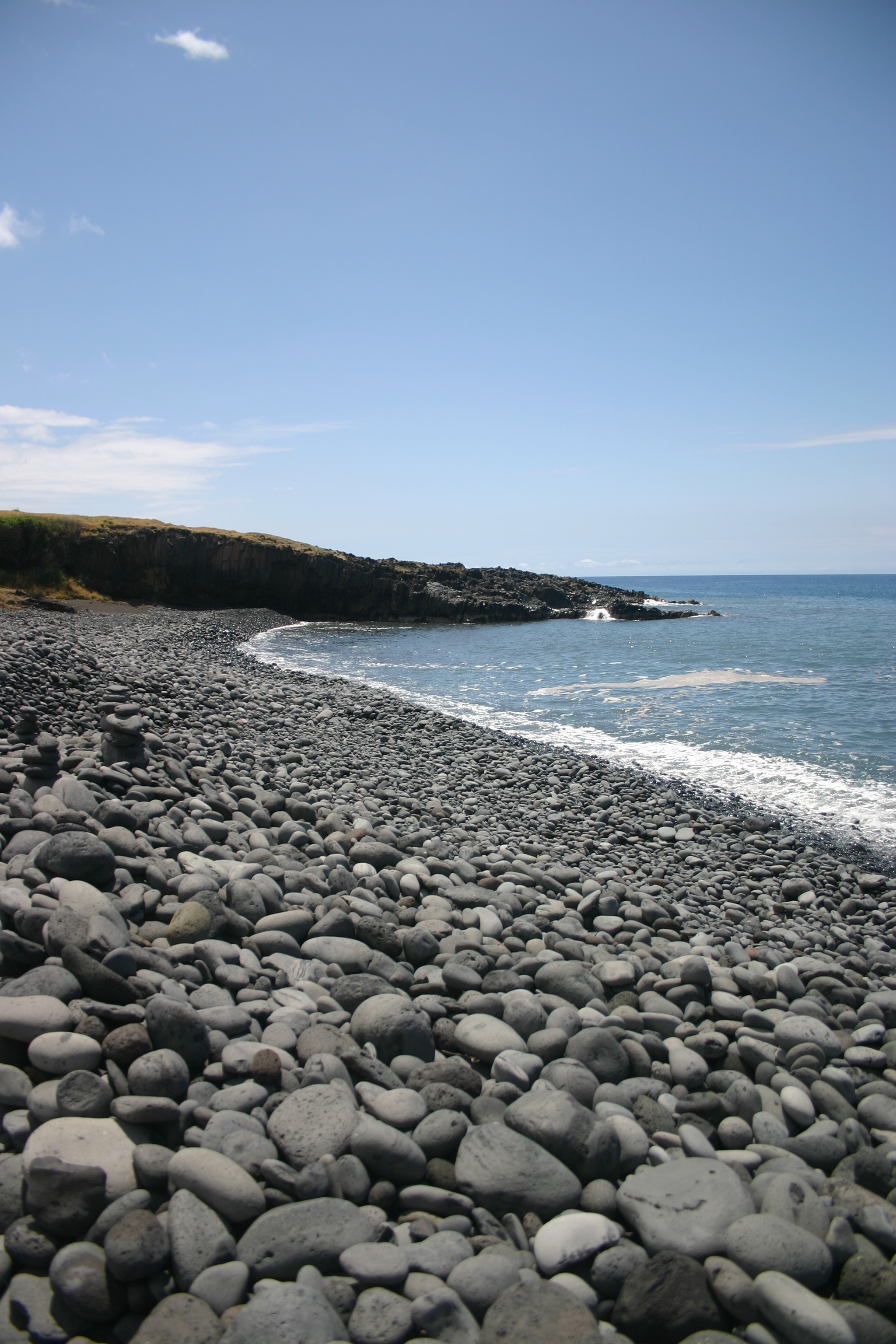
Black sand & rock beach
Following are Landmarks (with mile marker locations) that you’ll encounter as you drive from Kipahulu toward Ulupalakua:
(40.9 mm) Lindbergh’s Grave
GPS Coordinates: 20.651502,-156.054806
Just past the 41 mile marker on the ocean side look for the wood “Maui Stables” sign at Ho’omau Rd. This short road takes you to Palapala Ho’omau Church, the site of Charles Lindbergh’s Grave. The Hawaiian garden-style cemetery and surrounding grounds here are serene. Lindbergh held the special spirit of East Maui close in his heart, and when you visit, you’ll likely be able to feel why he chose this spot as his final resting place.
There is also small park (Kipahulu Point Park) accessible through the far side of the cemetery. The park is situated on the cliff’s edge overlooking the Kipahulu coastline, and is typically deserted. There are also two lonely concrete picnic tables sitting in the shade, just waiting for you to show up with your afternoon snack to keep them company.
Between the graves of Sam Pryor and Charles Lindbergh are six small informal grave markers. These small markers look less like graves, and more like chunks of an old sidewalk that children had scrawled their names in while the cement was still fresh. These faded slabs of concrete mark the graves for six of Sam Pryor’s gibbons. Pryor considered these small apes to be part of his family, and they were taken with him (around town, and around the world) as if they were.
Pryor, a wealthy airline executive, was also the person responsible for restoring this church to its original condition. Clearly his position afforded him significant influence in convincing clergy to allow animals to be interred beside humans, as Sam said “[to be] a part of posterity…there for my grandchildren to see.”
A colorful man many ways, Pryor came to live in Maui after WWII, largely because he was concerned about the threat of nuclear holocaust engulfing the mainland United States. Being a good friend of Charles Lindbergh, Pryor is also the reason Lindbergh found Maui. Lindbergh fell so in love with Maui on his very first visit, that he told Sam that he wanted to stay. Pryor responded by giving Lindbergh five acres of his land to settle on, and the rest is history.
(40.7 mm) Laulima Fruit Stand
GPS Coordinates: 20.651651,-156.059515
A hair past Ho’omau Rd., on the mountain side is Laulima Fruit Stand. Their claim to fame used to be a bicycle-powered smoothie blender – which, unfortunately thanks to the County of Maui is now gone (the blender, not the fruit stand!) 🙁 These guys certainly don’t deserve the lame review Maui Revealed gave them, and if you’re ready for a healthy refreshment break, this is a good stop for a farm-fresh snack or coffee.
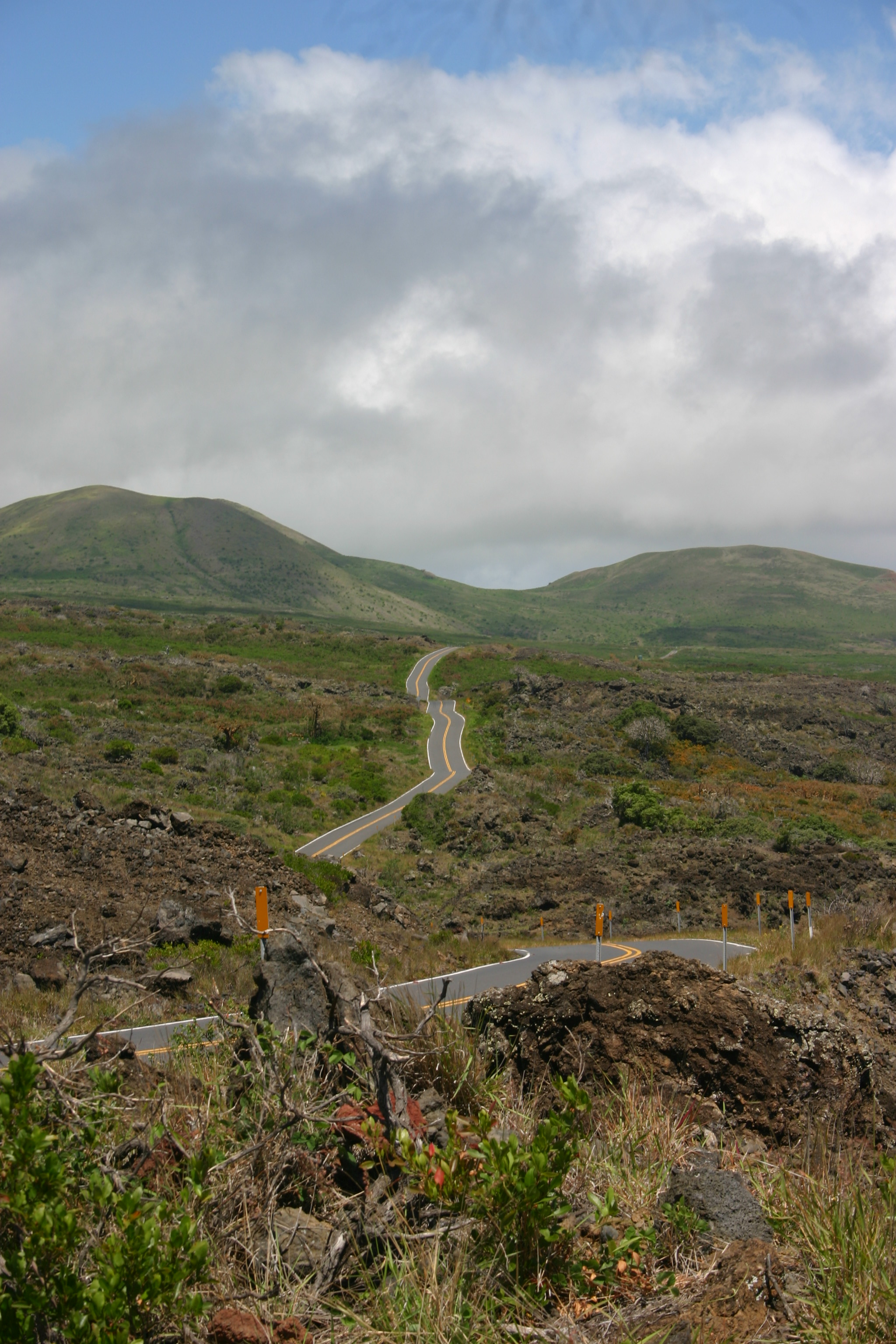
The long and winding road.
(38.8 mm) Alelele Falls
GPS Coordinates: 20.649943,-156.085596
Just before you get to the 38 mile marker you will descend to sea-level and a rocky beach. There is a white bridge, with “Alelele Bridge” stamped in the concrete. On the mountain side a couple well-marked trails head through awapuhi (shampoo ginger), maunaloa flowers and mountain apple trees to the 60′ high Alelele Falls. Outside of winter (the rainy season) the falls are frequently only a trickle – but the pool is spring-fed year-round with crystal-clear fresh water. There are places to wade-in and sit in the shallow water, and the pool is always perfect for bathing. The energy here is strong, and when the awapuhi is in season (mid-late summer) you can practically see the pre-contact Hawaiians bathing here.
(38.7 mm) Popoiwi Heiau
Popoiwi Heiau looks like a rock wall up the hill – much older than other recorded heiau – this was constructed by what are thought to be the first settlers of Hawaii, settlers from the Marquesas Islands. Heiau are religious structures, most often used to make offerings to the Gods. There are actually remnants of around 50 heiau recorded in this district, so you may see one of the others. (Most heiau are difficult to pick out without a guide.)
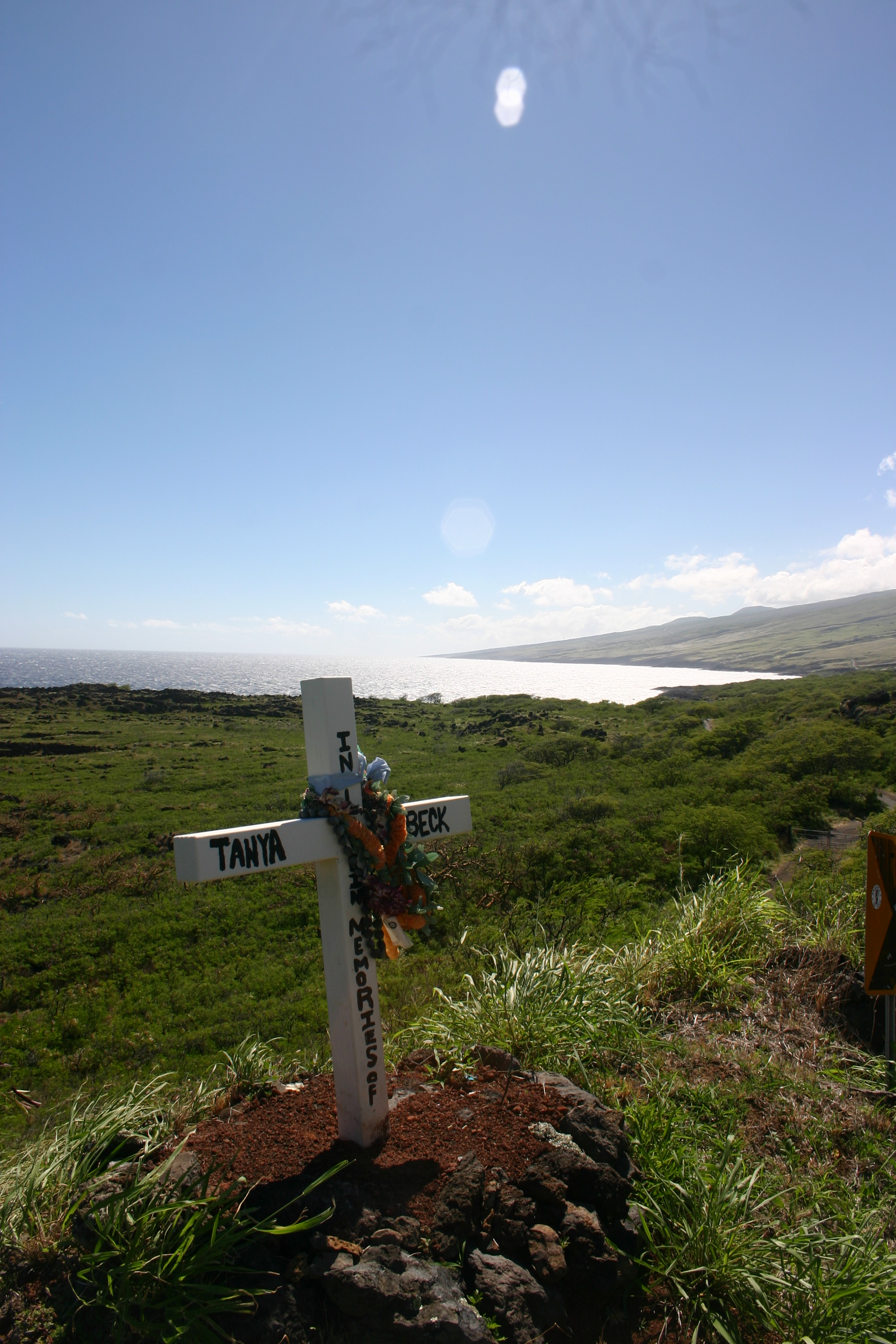
...more effective speed control than the reflective warning arrows.
An interesting side-note, is a theory that the second wave of Hawaiian settlers (from Tahiti) took over and began calling the Marquesan peoples Manehune (“commoners”, in Tahitian.) 1500 years later, the word was assimilated into the Hawaiian language to mean “lowly people.” When Westerners came and applied their somewhat broken understanding of Hawaiian, the definition became lost in the translation, and Menehune became the equivalent of Hawaiian forest elves.
(37 mm) “Oh, This is the Part of the Road Everyone Was Taking About!”
Around mile marker 37 the road becomes a mixture of paved and graded gravel/dirt road for 10 miles (after which it becomes a welcome stretch of brand-spanking new smooooth asphalt!) Believe it or not, you’ll find that much of the graveled road is a far better ride than the patchwork of paved portions before, during and after.
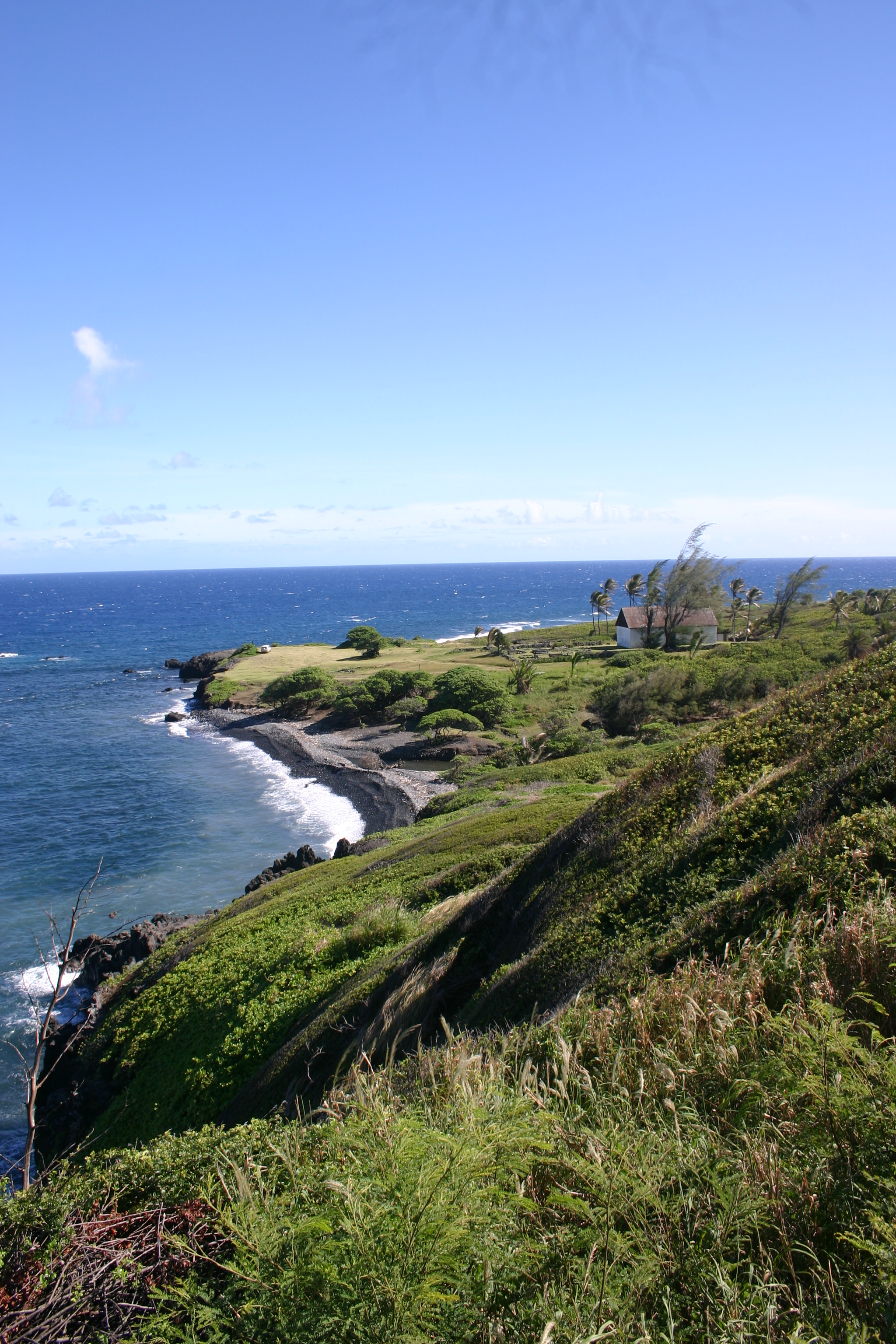
Mokulau
(35.1 mm) Mokulau
GPS Coordinates: 20.637609,-156.111842
Before you reach the 35mm a strikingly idyllic peninsula and church come into view. Dozens of small lava islets poke dramatically out of the ocean – This is Mokulau, which fittingly means “many islets.” There is a dirt access road at mm 35.1 that takes you to the Huialoha church and boulder beach. Don’t enter the ocean here, as the water is rough and the currents are unforgiving. The Huialoha Church was constructed in the 1850’s and lovingly restored by the Kaupo community in the 1970’s.
(34.9 mm) Kaupo Store
GPS Coordinates: 20.635895,-156.123646
Just past the 35mm is the Kaupo Store. This store is in the historic register and has been operating since 1925. A friendly, cluttered, no-nonsense general store unchanged from yesteryear. This is the kind of place you might have found “out in the country” (back home) 40 years ago – you serve yourself drinks out of an old white household refrigerator. There are old knickknacks, stacked here and there on the old rough-worn wood shelves. Old cameras and clocks are a favorite – but all kinds of odds and ends from years gone by humbly adorn this living time capsule. All said, this friendly place is largely going to be more of a colorful and friendly “last option for cold drinks and snacks” than a destination stop in itself. You won’t find another place to buy anything until Ulupalakua or Kula (where you will find most places close early!)
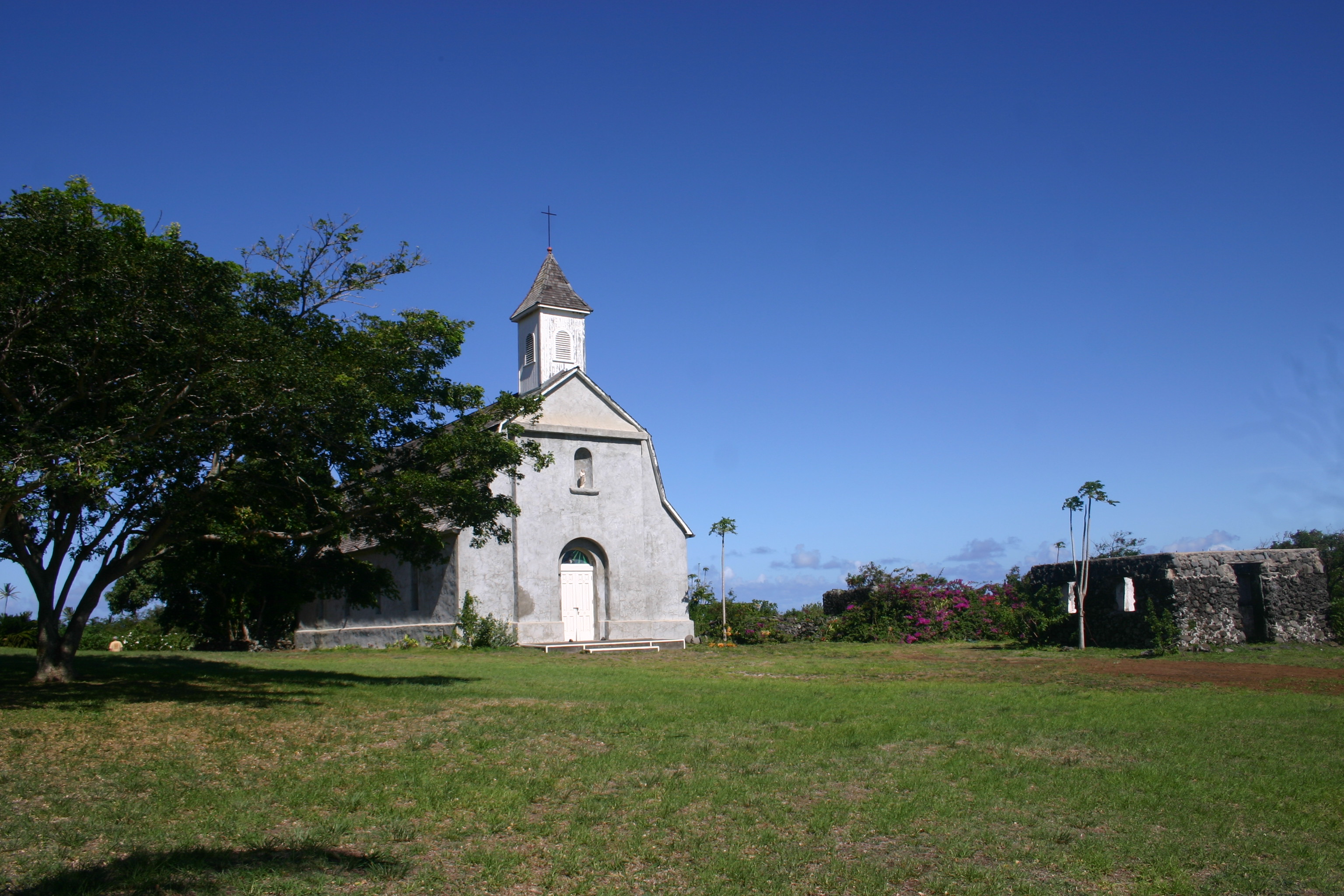
St. Joseph's Church
(33.7 mm) St. Joseph’s Church
GPS Coordinates: 20.634005,-156.138696
St. Joseph’s is an historic Catholic church built in 1862 and restored in the 1990’s. Now it is falling into disrepair, the roof leaks, and if something isn’t done soon it will probably become a ruin to sit alongside the remnants of the crumbling walls of the original church. The church reportedly holds services on the fifth Sunday of the month, but I couldn’t verify that as fact. The grassy lawn here is a great place to view the Kaupo Gap, as the church stands smack in the middle of the lava flow that poured out of it.

Kaupo Gap as seen from St. Joseph's Church
(33.7 mm) Kaupo Gap
GPS Coordinates: 20.702587,-156.147709
The Kaupo Gap: Take a look up to the summit of Haleakala. As you may already be aware, the Haleakala Crater is not actually a volcanic crater. The Kaupo Gap is a large opening formed from hundreds of thousands of years of erosion that was later partially filled back in by lava flows. Views of the gap are expansive and impressive, and as you’re driving through this area you can clearly see how the lava flowed down and filled in this area…wow, that’s a lot of lava!
(31 mm) Nu’u Bay
GPS Coordinates: 20.625198,-156.1795
Around the mile marker 31 area is Nu’u Bay. It is reported to be good for snorkeling and scuba – but I’m not too keen on recommending this place for anyone but intermediate to advanced divers and advanced snorkelers because conditions can be rough (especially in the summer) and it gets deep fast, with strong currents. If you’re a diehard and want to hit this spot, the gate is at 31.1 and a dirt road (may be 4wd depending on conditions) takes you to the parking area. Be sure to re-latch the gate shut when you pass.
(31 mm) Pu’u Maneoneo Petroglyphs & Village Ruins
As you pass mm 31 there is a trail through ruins of a pre-contact Hawaiian village with many intact petroglyphs. Many have been trying to find these, and they are currently contained in no guidebooks. Ed Fornataro who writes BigIslandHikes.com discovered the location a few years ago, and has written a dedicated article about the area for MauiGuidebook.com.

Huikini Bay
(29.9 mm) Huakini Bay
GPS Coordinates: 20.627887,-156.190708
A long beautiful rounded-rock beach that is a good pit-stop for just sitting and listening. When the waves crash on these rounded rock beaches it adds texture to the calming zen-sounds of the ocean’s rhythms.
(28.7 mm) Huakini Bay (Arch View)
GPS Coordinates: 20.624601,-156.209734
Another black sand/rock beach on Huakini Bay, this one is a great place to view and photograph the Pokowai sea arch. The sea arch is exactly like it sounds, a natural arch of land that formed with a hole through it.

Manawainui Valley
(27.7 mm) Manawainui Valley
GPS Coordinates: 20.622387,-156.222094
The Manawainui bridge is comically oversized compared to the road connected to it. Over-engineered by the federal government (imagine that), it has plenty of room for you to park and take a peek up the stunning Manawainui Valley. This valley is also breathtaking from a helicopter, with some of the most heavenly waterfall views on earth. Helicopter tours will put you back about $250/head, but if that kind of money is in budget, the experience is well worth the price.
After the tease of new road stubs connected to the bridge are in the rearview mirror, you’ll be happy to know that smooth asphalt is just one more bumpy mile away.
From here the road also begins to slowly climb away from the sea and up toward Kula at 3000′ elevation.
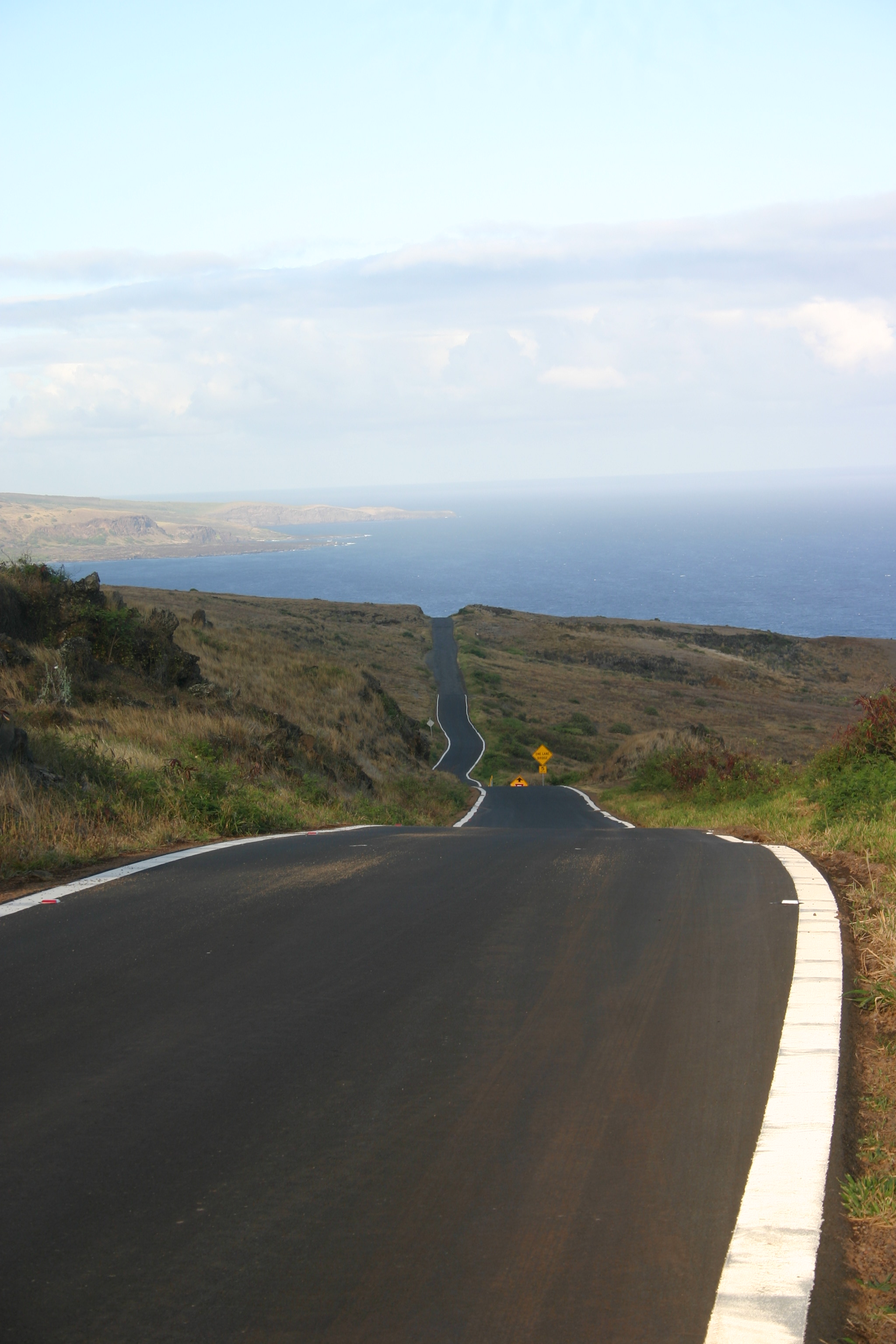
You'll have a whole new appreciation for this scene when you witness it in person.
As you begin your ascent, you’ll notice “new” lava fields toward the ocean. These are among the last eruptions of Haleakala, and in geological time, happened just yesterday. You’ll begin to have stunning views of La Perouse Bay, and behind you you may be able to see the Big Island of Hawai’i. As you continue further, Makena, Wailea and Kihei come into view on land, while off in the blue ocean our neighbor islands of Kahoolawe, Molokini, Lanai and Moloka’i come into view, one by one. From this bird’s eye view you can clearly see where “the wild” ends, and resort development begins – you also get a picture of how irrigation plays a role in keeping the developed areas of South Maui green. Further yet and the views become bi-coastal, where you can see entire south and north shores, and the isthmus in between. The views are memorable, and many.
The area in between coastal portion of the road and Ulupalakua is also home to Kahikinui (mm21) which is a slice of 23,000 acres from the summit to the sea (in the traditional ahupua’a) set aside for native Hawaiians, and which began to be resettled starting at the end of the 20th century. It is not much to see as there are few hearty homesteaders working with virtually no infrastructure – but it is the idea – a place that native Hawaiians can call their own, and fill a void that has ached in many of them to finally return to the ways of their ancestors.

Views of the coastline are stupendous
This area may look unforgiving now, but thousands of Hawaiians lived and thrived here prior to western contact, when the area was more hospitable and native dryland forest was still intact. (More info – link to AP News article from 1997)
As the road continues, it begins to wind through progressively greener scenery. You will then come to Ulupalakua, and the Tedeschi Winery. If you had a full day in Hana, it is likely past closing time, so the winery should be scheduled for a “Upcountry Day.” (also see Keokea-Ulupalakua article.) Beyond Ulupalakua is Keokea and Kula – you’re now on a real highway, which begins a much more rapid straight-line descent toward Kahului at highway speeds.
Key Info:
Mile Marker Span: #42 (Kipahulu) to #15 (Ulupalakua) (Pi’ilani Hwy aka Hwy 31)
View Back Side of Haleakala in a larger map
Julie says:
We drove it summer 2022, It got very scary when we received a HUGE falling rock from a cliff on the rental car. It was in a super remote out of service area. We did not feel safe.
At some point, we were 5 cars following each other on a narrow portion of the road and we had to go backward for almost a mile because there was a car in the other direction (not giving a damn…) and it was too narrow.
It was some of the most beautiful landscapes I ever saw in Hawaii, so unique, We are so thankful we got to see it but to be honest, we will never do the road again because of the falling rock incident.
SCS says:
Drove clockwise today, 8:30am to 5:30pm…. Road to Hana was busy, but never did have to backup…. Some tight spots but its not Going to Sun Road in Glacier in full size 1 ton pickup! Had rental Chrysler 300 and backside, west side was rough but doable. Liked being on inside, cliff side rather than drop-off side! Whole different environment and views on west side, not to be missed!
Mark says:
When we went, we ended up hiring a car service and boy are we glad we did. So much easier to enjoy both the back and front side without having to worry about that sketchy road.
Aloha
Gabe says:
September 15 2022 — Did the full loop this week, from Paia to Hana to Kaupo to Kihei. On the backside a bridge bypass has been setup but may be affected if there is any flooding. Road is in great shape for 95% of the journey. The roughest 5% will have you on the edge of your seat, but it will be worth it. The views are spectacular! A sedan could do it but you will want 5-6 inches clearance minimum, and the tires and suspension will be working overtime. You don’t have to leave at the break of dawn, but don’t get caught out there in the dark. Be mindful of sunset as driving west into the sun was absolutely blinding on the backside of road to Hana.
Jill says:
Thanks for all the useful info. We were planning to do this counterclockwise from Kihei to Hana (stay overnight in Hana) and then Hana to Paia. My friend on Maui just told me the back road to Hana is still washed out in parts and bridge is down in Kipahulu. Is that still the case?
Aaron says:
Yes that’s true. But there’s easy detours around themwashed out parts. The roads are just as this article describes them, I just drove this way last night. Paved section still feels brand new too. I was in a Tacoma, but my dad followed in a impala rental and did just fine
Donna says:
27 April 2022- NPS ranger told us not to drive the road. We did not listen. Went ahead in our Chevrolet Malibu. Took it easy on the road and honestly, super easy. No problems at all. First part of the road had potholes, unpaved portions but nothing treacherous. And like the author said, beautiful, different, and worth it.
Katrina says:
We are coming for our first visit in July. We will be doing Haleakala the morning after we arrive as I think we will still be on East coast time and up early anyhow. After arrival day we plan on spending 4 full days on Maui.
Would you recommend going ahead and doing full road to Hana the day after Haleakala? Or should we take a day or two enjoying some low key days before tackling the full route? We are also trying to figure out if we should just stay at one place in Kihei, or stay closer to R2Hana the night before?
Mark says:
I would take two days to do it, as The Road To Hana should be given a full day. I think moving your condo would take more effort than driving honestly. Enjoy!
R Russell says:
Drove the backside today in the late afternoon. Was pretty relaxing. Although rough and narrow in sections, the traffic was around 20:1 westbound so there was no need to back up at any point. The views were starkly beautiful, so worth seeing if you value aesthetics that don’t include waterfalls.
Jen says:
I visited Maui in September for the first time and will return (solo) with my 4 children (ages 16—-7) this month. Thanks for the great info…is it feasible to do the Haleakala sunrise, travel the back road and still make it to the 7 sacred pools and Pipiwai Trail at least to see the 200′ Makahiku Falls?
We tried the opposite way at the end of road to Hana to see the sunset and it was too late in the day though I cannot seem to find the actual time to travel. Thanks in advance and for all of this great info!
Mark says:
Yes, this will work well 🙂 – Enjoy!
Matt says:
This article was very helpful! I recently did the drive on 1//27/22 in my rental car. It was a Ford Mustang. As long as I took the road slowly and carefully in some spots, it was no worse than some poorly maintained roads on the mainland. We were very happy we took this road as it was a completely different experience from the jungle part of Hana Hwy. This road does require an attentive and careful driver, but it is not as vicious as some make it out to be. I hope this helps anyone on the fence deciding whether to do it or not!
Patrick Noll says:
Hey Mark. Very nicely written guide and looking forward to travel the back road.
I especially appreciate the mile markers, which will make driving and finding spots much easier.
I see in some of your response that it has been washed out. Do you know of any online resource to check the status or can provide some updates. Looking to do it on 2/7/2022.
Where would you get reliable info on the island? … Thank you!
Deepthi says:
HI
thank you for this article! Very helpful. We are visiting in December and were thinking of driving from Ka’anapali Beach round the back, directly to the Pipiwai Trail and then proceed to Hana and drive the route to Pa’ia. Is it a good time of the year to do the route counter clockwise?
Thanks
Mark says:
Currently the road is washed out, though it will probably be fixed shortly. Best to check locally when on-island if traveling Dec 2021.
Anne Kah says:
What’s the most reliable source for checking road closures? This now isn’t posted on https://www.mauicounty.gov/643/Road-Closure-Notifications
Mark says:
This is still the most accurate place to find current road closures.
Andre S. says:
Thanks for the info. We drove the Kaupo highway last week. It was in good condition with fairly light traffic (only a few cars coming from the west). We also did the highway on the north shore between Wailuku and Kahakuloa. This road, although paved, was a lot busier and therefore a little more tricky, especially because of the blind corners. But for someone who learned how to drive on steep logging roads in Idaho, it was a piece of cake. My passenger (who’s from Chicago) was pretty scared, though.
Gaby says:
Hey Mark,
Thanks for this bomb guide! Question – thoughts on driving a campervan through this road? Hoping it’s not too bad, in particular the elevation.
Thanks!
G
Mark says:
It depends on how gutsy you are, some parts are a tight squeeze, and for many it might be nerve-wracking. That said, it’s certainly possible and experienced drivers drive larger vehicles though every day. I guess it all depends on your level of adventure! Also (this goes for everyone actually) please give right of way to locals. 🙂
Colleen Christensen says:
Mark – we want to start counterclockwise also for the entire loop, With just roadside stops and not any hiking would you be able to make this loop trip in 10 hours? We can’t seem to get a solid answer. We’re not worried about the road, we have driven down 2 track roads and other roads like this. We just are trying to get a time line, we will be arriving and departing from OGG airport and we can only stay for the day.
Thank you for any information you are able to give us and thank you a honest article.
Mark says:
Yes, you could do that in 10 hours. However, currently the road is washed out, so check ahead 🙂
Karen C. says:
I would not drive a camper van around the far side, after visiting Hana. I just drove this in a car and it is a very narrow road, (one lane)
without guardrails on the edge of a 1000 foot cliff. It was very treacherous. The road is unpaved and very bumpy. It has gravel. I think a. Camper van would be too top heavy. It is very easy to go right over the cliff.
Lela Markham says:
We’ve driven the Kaupo highway a few times, starting in 1986. Coming from Alaska, where we call glorified goat trails “highways” it’s a fine road and not dangerous at all. The real issue is driving at night and cows on the road. The first time we drove half of it at night and nearly hit two cows who were just standing in the road. Fortunately, my husband is used to dodging moose, so we didn’t actually hit the bovines and now tell the tale with rueful laughter. Leave early enough to see it in the daylight, take your time and realize you can’t drive a dirt road as fast as you drive a freeway and you’ll enjoy a very special part of Maui
Vaishnavi says:
Hi, we are looking to do the Road to Hana counter clockwise, driving from Kaanapali at 6am. We are planning a day trip. Around what time can we expect to arrive at Wai’anapanapa State Park with a decent number of stops in this direction? The park requires reservations and it’s tricky to pick a time slot and then having to rush to get there! Also, would you recommend this counter clockwise route at this time of year (we are travelling last week of April)?
Christine says:
Curious if you did this and how it worked out? We are thinking about doing the same thing.
Lori says:
I’m curious if this worked too. Did you do it?
Henrick says:
Hi, I just completed the loop around Hana, and it was pretty crazy, luckily there was a small caravan of us, 3-7 cars at any time. I know for 1 I hate coming back down and being on the outside lane, seeing all the cliff edges on my passenger side freaks me out, so I opted to go all the way around. (I had gone to hana and back the day before as well). I would say that it does get pretty bumpy for about a 5 mile stretch, but the dirt roads are not a problem so much as the narrow one laners, but there are usually spots to pull aside and let one person thru, we had to do it about 3 times, not so bad. Also, as for type of car there was a nissan versa, a mustang and seabring. Mind you we left Haleakala (7 sacred pools at 5PM, the park guide said to not leave at 6PM. The sun was still pretty crazy in some parts, especially towards the end. And you reach nice roads a lot faster this way and the scenery is really nice. Oh and some of the dirt roads are actually quite wide towards the end, locals were passing us actually. Anyways, just my take on it, and I was driving a Jeep, which personally was big for what I m used to (Pontiac Vibe) so it made it a bit more unnerving. All in all worth the risk, give it a go. And that honk horn sign only appears twice on the road to Hana and one of those times is before reaching Hana. Cheers.
Brooke says:
Hello- great article! We will be spending 7 days in Maui and wanted your advice on what route to take? We are staying in Lahaina for 2 nights then Hana for 2 nights and ending our trip with a 3 nights stay in Wailea- which route do we take in Hana? Start time, etc? Would LOVE to also be able to do Haleakala (either sunrise or sunset) and we are from Washington and Oregon so we’re used to the dirt roads, etc! Thanks in advance!
Mark says:
Hi there, unfortunately the floods we just had have washed out part of this road and it wont be passible for some time. Check the Maui County website when you arrive. As far as what time to start, I always say as early as you are willing! Have fun!
Josh says:
It is open, just did the full loop on Tuesday.
Yona says:
Hi Mark,
Do you know if the road is still not passible? We’ll be there on April 22nd and would very much like to do the back side if we can. Thank you!
PS: I have not seen anything on the Maui County website but may have missed it.
Julia Breitman says:
We drove it last night and it’s perfectly passable. Bumpy but nothing that felt unsafe. Possibly I love this side more than the road to Hana
Trey says:
Mark – Are you saying that the road on the backside of Hana has been washed out in spots and is not passable?
ekoff says:
Avoid the road (death road) that loops around the western Maui along the northern shore,
and avoid the backside road that goes through Kaupo that loops around the eastern Maui along the southern shore. The views are spectacular, but the roads are very dangerous in my opinion.
Erica says:
Hi there, my family is visiting in January. We want to do Hana but I’m a little nervous about driving in the dark with other drivers so we would have to cut our trip short. Or. I am typically up fairly early and was considering driving the back way in the early morning (4:30, dark) and starting at Pipiwai Trail or would you suggest going around clockwise at the same timish and starting in Pipiwai?
Karen C. says:
Def, drive clockwise and don’t do any of it on the dark. It’s very curvy and treacherous and you also don’t want to miss the beautiful scenery. We just drove it.
Josh Parr says:
Hi- is it possible to car camp along this stretch. I’d love to take it easy and truly get a feel for this less crowded and more indigenous space..,,
Ken says:
You’re the best for putting this together. I’m definitely going to do the backside this spring. Do you know where you took that second to last picture, where it looks like the road will drop into the ocean? I love the shot and I’ve looked up and down google maps looking for where you may have taken the picture, but the ocean is always to the side and not directly in front of the road’s end.
Thanks!
Jacob says:
Just drove it today. What a beautiful drive. At times I feel like I’m in Nebraska and Oregon. The first 10-15 miles are kind of difficult but the rest is a breeze.
Kyle says:
Since the drive apparetnly needs the driver’s 100% attention, hopefully everyone will only be looking forward at the scenery. Is the scenery better clockwise or counter-clockwise?
Thanks
Mark says:
Aloha Kyle, the scenery is incredible both directions, however it is less frightening going clockwise 🙂
Dennis says:
Thinking of driving from Hana to Kula, driving up Haleakala for sunset and then overnighting in Kula before driving out to West Maui. Is that cramming too much into one day, or is there plenty of time to get to Kula by noon, and ample time to enjoy Haleakala views before sunset?
Mark says:
Hi Dennis – I think that plan sounds great as long as you were planning on an overnight in Hana before this. Have a blast, sounds awesome! -Mark
Laura says:
Why is it more frightening counterclockwise?
Mark says:
Because you’re on the edge of the cliff wen it gets close, instead of on the inside lane.
maya says:
Great article!
We’re going camping in the back side and my plan is to drive counter clockwise. leave papalaua beach park and drive to kipahulu (and camp), detouring to the top of haleakala on the way. we’ll eventually camp at waianapanapa and from there head to the airport. What do you think? anyone else doing counterclock wise? Thanks!
Josh says:
Doing counter clockwise tomorrow, curious how yours went
Logan says:
If you are not a Hawaiian National or Hawaiian subject I do not recommend traveling on the back South side of Haleakala. The “Maui Guide Book” site does NOT have authority to make such claims that it is indeed “ok” to travel on that backside road. Please when visiting the Kingdom of Hawaii come with respect for the culture and the Hawaiian people. mahalo nui~
Tammi Howard says:
My family and I plan to drive the backside in December. We will be hitting the road at 6:00am leaving from Kahului cruise port And using the Shaka app and will only have 8-9hrs to make our way around and to the airport. We have a list of must do’s and working in limiting ourselves to these stops. Will we be okay? Thank you for the great info and your feedback.
Craig says:
Just reading your question.. We had a small SUV and had no troubles. That back side is really unique.. There are a couple of tight spots past Hana and then the road opens up. We are from West Virginia so it really didn’t bother us. The switch backs and tight roads made it feel like home….albeit with a different view.. LOL
Inspire Uplift says:
Looking great! I’ve visited Maui several times and every time the rental car drivers showed me a fragment of the total viewpoints. I am astonished to learn the road map you have shared as this could have saved a lot of travel time.
Hannah says:
Hi – My husband and I are planning on doing the whole loop this Christmas. We’re planning on driving the backside into Hana, staying in Hana, and driving out on the ‘standard’ route before flying home. Our flight is at 1.45pm – what time in the morning would be a safe time to start our drive out of Hana (on 26th Dec) to make sure we get to the airport on time without feeling rushed!?
Mark says:
The clockwise route has many more places to stop and enjoy waterfalls and trails and you will want more time for that side. I would suggest going that way to Hana, so you can spend the time unhurried.
Judd says:
Hi Mark – Thanks for a great website! The backside of Haleakala is one of my favorite activities when visiting Maui. I’m wondering if you have known anyone to camp or if it is allowed near Nu’u Refuge? I’m looking for some off-the-grid camping spots in this area, but having a difficult time finding any information on if it is allowed or not. Thank you in advance for your time!
Mark says:
Hi Judd – unfortunately camping is very limited on Maui, and there are no campgrounds in this area.
Ralph says:
Hi Mark.We planned on leaving Lahaina around 6am in October and doing the whole loop clockwise. We would like to get back around sundown.That gives us around 12 hours.Is this doable?
Mark says:
Hi Ralph – yes, this should be a nice full day, and you will miss a lot of the heavy traffic thats usually on the Lahaina side on your way out.
BB says:
Great article. We took off on a rented Slingshot (closest thing to a motorcycle that you can get) and headed to Hana at 9am. Paia only has one stoplight in the middle of town, so to avoid a slow start, get through Paia before 9 am.
Amazing views! We continued on the south side of the island, not knowing where we were headed. It completed the Hana trip. Without the drive South, you only get half of the experience. Elevation changes, beautiful coastal views and severe climate changes complete the entire trip.
Drive slow, obey all signs and have respect, and it will be the drive of a lifetime.
Darren says:
Still a fantastic drive! Thanks for the excellent advice to take the road less travelled.
Enjoyed the very limited counter-flow traffic, and loved the 10 miles of smooth roller coaster pavement in our rented Camaro. 🙂
Paul says:
Love your website. We’re visiting for the first time in early April. 2 adults and 2 older teens. Weather permitting, I plan to drive (SUV rental) from Wailea round the back side directly to the Pipiwai Trail and hike to the waterfall first. Then we will grab lunch in or near Hana and drive the main road back to Paia. I figure we can stop at some of the highlights on the way back in the afternoon and maybe avoid the biggest crowds. Does this make sense? Thanks
Mark says:
That sounds like a plan!
Carol says:
We will be doing the Road to Hana from Wailea one day, staying in Hana, with some exploring (Seven Pools, etc.) on the second day, staying again overnight in Hana, and then leaving Hana the next morning for our flight from Kahului airport departing at 2:53. I am wondering if it makes more sense to drive the ‘north’ Road to Hana route in the reverse direction from the one we will have driven on day one, or do the Back Side route from Hana to Kahului. It seems like the backside might have less morning traffic. Is that correct? Would you be able to estimate for each route what time we would need to leave Hana to make sure we could catch our flight with no difficulty (including a rental car return) assuming we made minimal stops?
Mark says:
Hi Carol – If it were me I would return to the airport via the backside. Give yourself 2.5-3 hours – should be plenty so you can stop a few times. Grandmas Coffee House in Keokea is about a half an hour from the airport, so if you get there way ahead of schedule, go ahead and head in for a yummy lunch or some treats!
JP says:
I’d recommend the north side (Hana Hwy) heading East to Hana. Twin Falls, Garden of Eden, Black Sand Beach are good options along the route- grab an inspiring, sugar cane drink from Huelo Lookout too. Barefoot Cafe @ Hana Bay is a solid choice for some classic Hawaiian breakfast/plate lunch.
Like Mark mentioned, taking the south side/Piilani Hwy back to OGG would be the best, there you could visit the 7 Sacred Pools, Lindburgh’s grave…and a few other ‘road side attractions’. Grandma’s is a great place to visit in the Upcountry. Good coffee and eats…but, if you have the time (at the latest you need to ‘be’ @ the airport by 130PM for a 3PM flight), I highly recommend the Ulupalakua Ranch Store; accross from Maui Wine! Their grill usually fires up around 11am and they serve up one of the best burgers EVER! Beef, elk, venison, lamb……all raised there at the ranch and so good. If you have a few xtra minutes then pay a visit to Maui Wine, they have shipping and travel sleeve options if you want to bring back a bottle…..or more (they open @10am)
Then enjoy the 30-40 min. scenic ride back to Kahalui. The Upcountry is a slice of Heaven on Earth.
Jon says:
We will be driving from wailea to Hana and staying two nights in Hana then heading back to the airport. We would like to catch a sunrise at halakei. What sequence would you recommend. We were thinking of heading from wailea to Hana on the north road heading east and spending the day working our way to Hana. On the second day spending the day around Hana and going down to the seven pools. On our departure day getting up super early and driving to the state park for sunrise. Does this make sense or do you have a better sequence. Also if we did this would be travel the back way to the park for sunrise. Thanks. Great info
Mark says:
This all sounds perfect 🙂 Have fun!!
Merissa says:
Appreciate the recommendation. Will trry it out.
Thomas Gayer says:
we drove the road to Hana and went on around. we found it very nice, easy drive and stopped at the beach but were too late for the winery as it was closed. Much easier than making the mega turns from Hana to Paia. When we go again we will do it in reverse and see the winery, beach and Lindberg grave before we go to Hana.
Tom Mahowald says:
Did the back road from Hana with my wife yesterday. Beautiful trip with absolutely no problems. Yes, the road is narrow in spots and can be a bit bumpy. But if you drive with care and at a prudent pace you will find it very enjoyable. The views are spectacular and the last 25-30 miles of the road back to Kahului appears to have been recently improved and is a very nice surface. We actually found the back side to be easier to navigate than the very curved and restricted view trip out to Hana.
Two suggestions. First, leave early to increase your enjoyment and decrease the traffic and stress. We left the Costco in Kahului at 7:30 am and the resulting traffic was very light (although it was early December) the entire length of the trip. I cannot imagine what a freak show it must be to go back against the traffic around 600+ turns on the way home! Second, watch the weather and make the trip on a sunny day, if possible. If it is rainy I suspect the degree of difficulty can be much higher—on both stretches of road.
Take the less traveled road and enjoy the wonderful vistas. We did the round trip, with multiple stops and lunch in approximately 7 hours.
Lord Dima says:
Thanks for trip report. We are about to do this in couple of days, so encouraging to know things have improved on that side!
Nidhi says:
Great Article. Every word & description stands true. You appreciate the road more when you really witness it. We went in Jan 2018 & will highly recommend it. It is bumpy ride. But views are spectacular. We had an SUV with 2 kids so did not have the bumpy road issue. Totally worth it. Just make sure you leave the Seven sacred pools in time to have a save drive.
This should be a must do in Maui.
brian says:
we just did the entire loop today. a few tight turns and a little bit of gravel road, but no issues. We were in a Malibu. Great views!
Rocko says:
What time did you go near the closure area?
Alexis C says:
Did you stop at the ohea’o pools (seven sacred pools) or notice if that area was open?
Mark says:
As of August 2018 they are still closed.
Alexis C says:
So have the pools reopened then? I heard and read they’d been closed for awhile
Ed Gilmore says:
I have made 6 trips to Hana over past years. I drove the back road one time. Big mistake. In my opinion it is really too dangerous. I think it should be closed until it is paved.
ioana says:
It is really not too dangerous. I drove it too and it was breathtakingly beautiful! In fact, I drove the whole loop and I’m very happy that I’ve done it, otherwise I’d have missed seeing some if the most beautiful parts of Maui.
B says:
I agree! The best part of the Road to Hana!
Andria says:
I don’t get this at all. We had no problem at all, and we were in a minivan. Only a few miles are unpaved, but it is graded gravel. And not nearly as many “dangerous” areas as the Road to Hana and Kahekili Highway. In fact, I’d rate it the safest of the 3 as far as dropoffs. Love the area so much more than the northern road to Hana, where you can’t see anything but plants for 95% of the drive. The expansive views down the water from Kula to Kaupo can’t be beat in Maui.
Pono says:
The “backside” will be closed all weekdays starting February 5, 2018, until around the end of August. Here’s the County’s info about it:
https://www.mauicounty.gov/CivicAlerts.aspx?AID=8846
Lisa says:
I checked out the link, it shows road closed during working hours which is 7:30-4, so it should be open after 4:00?
Scott says:
It would seem this link is down – hoping to drive the backside in March and would love to know if it’s open.
Kristoffer says:
I drove the backside in the late 80’s a few times in an old VW Beetle with no problems. There was an unlocked gate with a “road closed” sign on it which didn’t do much to deter me. I’ll have to admit that there were a few nerve rattling sections to pass through, and if I remember correctly was almost entirely gravel, but I was young & restless after 3 months on the island and up for the adventure. I’m returning to Maui in April for a week with my wife & teenage daughter and was wondering if the road was open & in better shape than it was back then. It sounds like it hasn’t changed that much.
Sydney says:
We are hoping to do the whole look, including this backside drive next week. We will be leaving from Kaanapali around 6 am. Would you recommend we start with the south side and go counter-clockwise? We would like to get to the Oheo Gulch and the Pipiwai trail as early as possible, so were thinking we’d make a few quick stops on the backside road while enjoying the scenery driving and then get to the Oheo Gulch earlier than if we did the drive clockwise (as the stops along the road to Hana would probably take longer). Thoughts?
calum hawker says:
It’s fantastic to see such a useful post. Thanks for the sharing, I also found a useful service for forms filling. Just look at the service
https://goo.gl/6uU1RI. Its pretty easy to use. I think you can get a free trial if you ask for it.Residents of kipahulu, Kaupo, Hana says:
We locals don’t want rentals going the back side of Hana. We have asked the state, DLNR and county to intervene. It’s dangerous for us and you. Stop telling people to drive it
The rental car companies advice not to take the rental that way “read the ticket contract” off road! It’s even in the map they give you.
We take offense to drivers that disrespect our Aina. Your visiting our island be respectful. We are tired of putting up with visitors that don’t.
Don’t stop on a bridge it’s illegal in all 50 states. Don’t stop on the road to take a picture. Don’t stop under the signs that say no parking at the waterfall. Don’t drive slow and if you do pull over to let us pass. It’s common sense. Don’t trespass on our land because a stupid non local wrote a book “maui reveled” and said you can, “NO you can’t”!!!! Just because we don’t have signs everywhere doesn’t mean you can go in! Even when we gave signs you still go in, Stop it!!! Your here visiting you didn’t buy the island and yes the signs are for you not everyone else but you! Stop throwing garbage out the window. The Yield sign must be respected specially at a one lane bridge. We are not here to teach you how to drive or be a respectful human being so if you don’t like what we are saying here please don’t come to our island. We don’t go to your home and disrespect you.
Scott Charette says:
I can appreciate what you are saying about respecting your island, it is beautiful and everyone should respect this beauty. That being said, you need to address your concerns with respect. The visitors to your island make your economy, please remember this.
Mark says:
Scott, virtually all of the tourist money flows off of this island as quickly as it came. Few of the locals who live in Kipahulu are benefiting from the tourist economy. Even for those who are, to have an attitude that your money somehow bought you the right to impact the people or environment negatively IS the problem. What I suggest, and this applies to any visitor anywhere, that everyone visit with the humility of a gracious guest, rather than a king who paid to do as he pleases.
That said, the original comment is written from anger, and polarized pigeonholing all white people as being one way – but if you can see past that anger with some understanding of what it must be like for those who have lived here all their life watching the land and lifestyle being taken away for nothing in return, there is also a lot of truth in there.
Peki says:
Oooooh, auwe! aloha ‘ole, you!
Raquel says:
I drove this route 30 years ago and was terrified. I respect your island very much and will not travel the roads anymore. God bless you for letting us share your island and I hope all visitors will feel the same.
margaret anderson says:
When I visit your island respect is foremost on my mind. Understand what you are saying and can clearly hear the frustration in your words. I have witnessed tourists disrespecting the land and not okay. As a tourist coming up behind another tourist who has slammed their brakes on to get that perfect photo is dangerous and irritating. So know that there are tourists that treasure your land and treat it with respect.
linda says:
I agree….it happens all over the world; disrespectful tourists come and destroy the beauty and/or history that should be seen and admired. Pretty soon a site is so contaminated/destroyed that it’s deemed unsafe and a wall is erected to keep the fools out and no one can enjoy it. Respect people…..respect!
P.S…….I’m not a resident, just a respectful tourist.
Melinda says:
The Earth is a beautiful treasure that only humans can appreciate.
The Earth is a beautiful treasure that only humans can destroy.
Wherever your feet tread, remember that respect is not given BUT earned.
Reflect on your contributions to the macro- AND micro-cultures you happen upon, whether purposeful or by chance.
Your mere presence will leave a lasting impression: make sure it is positive for not just yourself BUT for others directly/indirectly impacted by your presence.
Strive to be socially respectful and responsible anywhere AND everywhere you venture.
Life is full of ANDs and BUTs, though not intended to use as an excuse for ignorance.
Chris says:
I would highly recommend making this drive… some spectacular sweeping views — probably my favorite drive on Maui.
We made this drive today in a rented BMW convertible, and it was just fine. Many other convertibles and compact cars were on the route as well. The unpaved portion of the road wasn’t bad, and the most rough stretches of paved road were definitely bumpy but didn’t have large ruts that would prevent you from safely passing through. Just drive the appropriate speed for the conditions and watch for potholes and you’ll be fine.
dale clark says:
Chris,
thx for the update. we’ll be in Ka’anapli from 11/4-11/11 and plan on “doing the south loop” in a mustang convertable. we did the north loop two years ago and had no issues with the one way portions.
\000/
mahalo
ioana says:
“I would highly recommend making this drive… some spectacular sweeping views — probably my favorite drive on Maui.”
– I second Chris, definitely recommend it too!
Karen says:
Thanks for the great info. What is your opinion on driving the back side from the other direction? We are taking the Road to Hanna a different day, but on this day we plan to take in the sun rise, breakfast at Grandma Coffee House, then drive the back side to the Seven Sacred Pools and hike to the falls before the crowds arrive. We felt making the hike after the Road to Hanna was too late in the day. Especially having to drive back to Kaanapali. after that. What do you think?
Mark says:
Sounds like a great idea to me!
Kate says:
Hello, we are staying in Wailea next week and planning to do the same (counter-clockwise to Hana) leaving at 3. We do not plan to make any stops. How did you find the counter-clockwise drive? As it sounds like most drive clockwise I want to make sure there is enough room to slowly pass another car or pull to the side to let a car pass. I also wanted to see if you think we will make it to Hana (where we are staying the night) by dark if we leave at 3.
Julie says:
Hi,
We are planning on taking the the road to Hana and stopping off to hike and go to the seven pools and maybe a few other stops along the way. What time do you suggest leaving Wailea in the AM so that it is not too crowded at the pools/ hike. How long do you think this entire trip will take?
Thanks!!
Mark says:
Aloha Julie – I suggest giving yourselves the whole day and leaving as early as possible. You’re leaving this comment in the Back Side of Haleakala article, so I imagine you are going the whole way around. You will not make it there before crowds unless you leave super early and zoom though a lot of stuff you should be checking out! Have fun!
Sara Inberg says:
Hey Mark!
Thanks so much for doing this website! You convinced us to do the backside and it was our favourite part of our trip! Seriously amazing landscape! Love it!
Mahalo!
Sara
Sara Inberg says:
How did it go Julie? We started out from Kihei at 630 and drive right to Hamoa then back tracked. Next time we’d start at the 7 sacred pools first though because at 9 am nobody was there! If you watch aloha stoked videos on YouTube you can get a few “secret spots along the Hana road that are gorgeous!!
Lena says:
This is the absolute best driving route on Maui. We enjoyed it far more than the more famous Road to Hana. Must-do!
Darren says:
The back road from Hana past Kipahulu was a great choice and a great alternative for the return trip as opposed to doubling back on the Hana Hwy. I would recommend a Jeep as we had driven though we did see lots of convertibles, minivans and compact cars pass us on the road. I would not fear the dirt road portions as to be quite honest it was a much smoother ride than some of the patchwork asphalt sections. Recommended to use your horn on approach to the blind corners especially those hugging the sea wall before Kaupo. A great trip back and a great look at the lesser traveled side of the island.
Nicholas Lee says:
Did this on Sunday, my first day in Maui. Road to Hana and then the south side. It was awesome. I saw people doing it with little economy cars and camero’s, not smart; they didn’t know what they were getting into. Thanks to this blog, I was! (took a Jeep) Left at 0830 and got back around 1830.
Keisha says:
What happened to all the green?? My husband and I did the drive back in 2010, this was my favorite part… Your pics are how we remember it. But it was brown and appeared scorched this week, just lack of rain? I could see it was green halfway up the mountain… Still beautiful coastline of course and a fun drive!
Mark says:
Yes, much of this area is much more frequently brown than green as it is virtually a desert.
Rob says:
It was brown because winter is usually the rainy season and when the Haleakala hills will be green! I’ve done this drive in 1994 in a Corolla and in 1996 in a Taraus. Never a problem with either on, but I did follow the habit of honking going around the bends coming out of Hamoa. Just don’t honk horns in Hawaii in general! It’s frowned upon!
Jamie says:
Thank you so very much for your Road to Hana suggestions! We will be doing the day trip from Kapalua. We will be adding on the 7 Sacred Pools as our final destination on the trip. Where does the loop take us? Do we drive back through Paia / Kahului or via South Maui? What would be the total time from 7 Sacred Pools? And finally, where would you recommend that we have dinner?
Thanks again!!!
Jamie
Trae says:
Hi, Most locals seem to discourage taking the “back road”, but seems you say it can be done. Is it safe to say, that it’s ok for our trip end of April 2016? Would love to stop at the Kaupo store!
Ryan says:
Aloha Mark, Hawaiian Ryan here. Would u happen to know what mile marker turn offs take u to the ocean backside? Spring break is here, and I like take da wife and keiki for do some daytime big pole n plugging. I get 4wd and would love for our ohana to be as secluded as possible. I enjoy your website and plan to take the family out and do some hiking in hana. Something different for us. Mahalo brah!
Mark says:
Hi Ryan – no I don’t have the mile markers, but sounds you’re local and you understand where/where not to go – so if you use your best judgement there are many fairly obvious places that fit your description 🙂
M. Fitz says:
Hello,
I wanted to ask you about timing
We are arriving in Maui at noon on a Wednesday and driving directly to Hana where we plan to spend 2 nights.
On Friday morning we’d like to leave Hana and get all the way to Wailea by Friday evening. We’d like to see the 7 pools, and continue around Kaupo to Keokea. As I understand it, there is no access from Road 37 down to Wailea. So we need to drive all the way up to Kahului and then get on Road 311 to head south to Wailea. Is that right?
Will we have enough time to do all that (Hana to Wailea) all in one day, if we’re moving at a leisurely pace? We do plan to stop at the 7 pools a few other spots.
Thank you for the help!
Mark says:
Aloha – that plan sounds great, and yes, you do have to drive the long way around though Kahului. If you are coming this week, there is actually a wild fire in Ulupalakua area that has the road temporarily closed, so check for that first!
Andrew says:
Aloha Mark,
How/where do we check to see if route 37 is open? We made the mistake of not checking before driving this morning and were stopped at a road block. I now know the closure is from feb 16-19, but is there an updated website for that? And if we got to the road closure point (coming from the airport) before 7:00am would be able to cross? Lastly, is there a good website to check the fire and its affect on the road closure?
Mahalo!
Andrew
Mark says:
The county posts road closures here.
Anna says:
Thank you so much for this information! I am traveling solo and hoping to drive from the Kipahulu campground back to the Kahului airport in time to catch my flight. I know this is probably dicey, time-wise, but I’m wondering if you think it is doable to leave around 7am in time to return my rental car and catch my flight at 12:30? I figure leaving about 3.5 hours for the drive, then an extra hour to return the rental car should get me to the airport by 11:30. Any thoughts/advice? Thank you!
Mark says:
Aloha Anna – that is doable. I think your time frame is perfect. It will give you time for a few quick stops and it won’t take an hour to return your car, either 🙂
Sommer says:
Is this back side pretty wide? Would a suburban be able to navigate?
Mark says:
It’s wide enough one direction at least – there are places where you will have to negotiate with oncoming cars – but thats true no matter what the size of your vehicle.
Laura says:
Thanks for the great review!
We are driving to Hana from Kaanapali in February and spending in 2 nights in Hana before heading back to Wailea. We will be in a minivan with a 16 year old, and a 3 year old.
Our plan is to do the Seven Sacred Pools on our full day in Hana, and then do the back side drive back to Wailea for the return trip.
My question is, how long does the actual driving portion of the trip take? Obviously, there will be lots of stops, but I”m just curious about the driving time.
Thanks!
Mark says:
I would guess 2-3 hours each way. Its hard to say exactly, since I never care to check what time it is or how long it’s taking once I get on that road 🙂
Laura says:
Thanks, that still helps, since I know the times Google is giving me have to be way off.
Wish me luck that the 3 year old doesn’t get car sick, so far he has been ben fine on some windy California roads, but they don’t quite compare!! 😉
Laura says:
Anything in particular, other than Pools of ‘Ohe’o that you suggest that we do while we are in Hana for a full day?
Melissa C says:
Hi Mark,
Such great info, we hope to travel the entire road this coming Monday. We did this 2 years ago & survived a flash flood at Alelele Falls, can’t wait to see it again. And can’t wait to see the back side of Haleakala in daylight as it was past sunset when we got back to our car.
Quick question… I read that the Alelele Falls access is now closed as of summer 2014. Do you by chance know if this is accurate or just another deterrent? Thank you again!!
Harvey says:
Hi Mark,
Thanks for the detailed posts. Regarding the hairpin turns around sheer cliffs:
– Is this area paved?
– Are there guardrails around these turns?
– About how many miles of these turns are there?
Thanks in advance.
H.
Mark says:
Aloha Harvey – I’m going to suggest if you have these questions it may not be the road for you! The road is mostly paved, and there are some sporadic guardrails, but still plenty of places to go right over the edge if you don’t pay attention or are a poor driver. The entire road is turns, much of it is narrow.
Ray says:
Hi Mark,
My family will be staying in Kula in late January and we were actually thinking of following 37 heading south, then on to the Pi’ilani Hwy heading east to Kipahulu. We would be leaving early on a Saturday morning and hoped to reach the ‘Ohe’o Gulch area before noon. Everything I’ve read about the Hana Hwy and the Back Side of Haleakala, however, seems to indicate that people drive the other way. Does it matter? The whole ‘cows and cliffs’ issue is making me want to be very careful about how I plan this!
Thanks
Rebecca says:
Hi Ray,
Did you end of doing this reverse direction. It is now 2018 and I have the same question as I plan an upcoming trip. (I heard a section of road is closed during the day right now so I have to check the map, etc. It may mean we can’t do this drive this year). I did the RTH drive in 1997 all the way around and look forward to seeing Maui again.
I hope you had a great visit.
thanks,
Rebecca
Erin says:
HI Mark,
Do you think it is doable for us to do an early morning sunrise at Haleakala, then drive the backside and do the road to Hana backwards all in one day?
This is my second time there and I drove the backside last time and definitely want to do it again 🙂
Mark says:
Aloha Erin –
I do think that is doable if you focus your Road to Hana trip. I would focus on Oheo (aka “Seven Sacred Pools”) because you will be coming around that side earlier, and it’s nice to get there before the crowds show up!
Joe says:
Aloha! About how long does it take to go from 7 pools to keckea taking the back side road? Were looking forward to it on saturday if the weather stays favorable on the east side.
Mark says:
Without stopping 1.5 – 2 hours depending on your comfort level with the road. Thats a real ballpark figure, I’m kind of guessing – I always stop!
Joe says:
Thanks! We drove it yesterday from hana and it took us 4 hours from hana to kihei with several stops. It was abaolutley beautiful, green the whole way!
Al says:
Have done the back side a couple times but never stopped once past the 7 pools, never knew what to look for or if it was Ok to do so, I’ve seen the churches as I drove by and wondered about going down, now I know we can. We’re going back at Jan 2016 for a week on Maui and a week on Kauai. We’ll surely do the trip again and stop at all your suggested spots. I didn’t really enjoy the trip to Hana, too much traffic and commotion, too bad there isn’t another road out of th3 7 pools area other than back the Hana road as I’d start my excursion on the backside and exit out on another route around the pools, just backtracking again wouldn’t be as fun.
Jennifer says:
Hi Mark – My husband and I are going to be in Maui next week and have one day to do the R2H. We will be coming from Wailea. The two sites that I really want to see are the 7 sacred pools and the Pipiwai Trail – but we have dinner reservations at Mama’s Fish House at 8:00 pm. Since we know that we want to see these items, what are your thoughts on us doing the R2H counterclockwise so that we go 37-31-330-360-36 and end in Paia?
Mark says:
Aloha Jennifer – that could be done that way, but I would suggest dining at Mama’s on a different day than Road to Hana altogether.
Tom says:
We drove the road to Hana today and continued through Hana to do the backside of Haleakala that you describe here. I found it to be a more enjoyable (fewer locals pushing us) and fascinating drive than the road to Hana, namely because of the many and sudden changes in ecosystems. The entire trip made for a pretty long day, and we were both ready to get out of the car by the time we were overlooking Lapérouse Bay and Kaho’olawe. Not sure that we will ever get back to Maui, but am so glad we saw the back side of Haleakala.
Josephine says:
we love this road trip and do it every visit to Maui.
this year we are planning to start in Kula and drive the whole way backwards!
Leane B says:
Hi Mark,
Thank you so much for all this wonderful information. I am heading to Maui in June and plan on doing the Road to Hana (I did this once 20 years ago, but did not get to spend enough time). We will be in Maui for 5 days and have left 2 days for the road to hana. However, staying overnight in Hana is not going to work for us. I saw your “Shelby” articles but am still a little confused. Would your suggestion be to drive the ‘regular’ way into Hana on Day 1 and then go the ‘reverse’ way on Day 2? Thanks in advance for any info you can give 🙂
Mark says:
Aloha Leane – yes, the second day I suggest taking the back side. Have a wonderful time!
Grace says:
Thanks for this resource; because of it, I decided to take this route. In my opinion, this part is even better than the Road to Hana. I just wanted to drop you a line and give you an update on St. Joseph’s Church.
We took this route on March 26th, 2015. It was a Thursday and we were so luck to have met two of the descents — they both had grandparents or great grandparents berried in St. Joseph’s Church’s cemetery. The gentleman would come every Thursday to cut the grass and keep the ground. The lady told us that every 5th Sundays, there will be a church service. It happened to be that coming Sunday. A priest from Hana would come and people from all around will come for the service. Through donations, they were able to fix up the church’s roof and the church looks in great condition. So I thought I would let you know.
Thanks again for this great resource!
Ellen Y says:
Mark,
Great info! We will be staying near Pukalani for 3.5 days and plan on spending time exploring this part of the island. On the first day we’d like to wake up and drive to Haleakala, we don’t have an agenda other than zip lining, seeing sights and having fun. We will drive back to our house each night. Will you recommend a route coming back and forth from Pukalani?
Dave M says:
I have done the wonderful tours twice and I highly recommend them. They will provide a history & fact filled narritive. And no, I have no connection to them. That said, to me driving CW would be the most sensible. You will be going with the bulk of the traffic flow. All the tours go that direction. It’s an all day trip. You had better be comfortable with slow windy roads, with some pretty stunning exposure in places. Cliffsides portion of a few miles of it is narrow, dirt, and in some places, when looking out the window all you will see is water a few hundred feet below
Caroline says:
Aloha, Mark! If we leave the Mountain Winery at 11:30AM, do you think we could make it to The Pools of Oheo by 12-12:30PM taking the back way in reverse?
Sare says:
Mark,
Thank you SO much for this information. We are coming into Maui at 4pm on a Wednesday in July. From Thursday night on we will be in Wailea. We were thinking of staying close to the start of the RTH on Wednesday night and waking up Thursday and doing the full drive around to end up in Wailea that evening. We have drive the RTH before on our honeymoon (2002) but not the full way around. Would this be too much to do in one day, do you think? Thanks so much for any advice you can give!
Mark says:
You can do it in one day, of course you can do more with more time! To do it in one day, some planning on the top 2-3 things you want to do and knowing what time you need to be there by would be very helpful! Check out these two articles, they may be very helpful – you will need to tweak it for one day, but it can be a great place to start: http://mauiguidebook.com/?s=shelby – have fun!
Harsha says:
Hi Mark,
I will be in Maui in Mid Jan of 2015 and planning to do the “full loop” of the Road To Hana. Starting from Khei I am considering driving Hwy 37 and 31 east to get to Pipiwai trail as that is the thing I am most interested in doing on this day. Considering the season being mid-Jan would you recommend I do the RTH in the anti-clock-wise direction? I am concerned about rainy season and road conditions and driving back on the “regular RTH” part in the later part of the day. Thanks!
Mark says:
Check for flash flood warnings, or if there were storms just prior, sometimes there is a part of the road that can wash out, though it is typically fixed within days.
Rodger says:
Hi Mark – My wife and I are planning on taking this trip at the end of Mach 2015. We would like to take the drive just as you stated. Getting up early and go clockwise around Maui and then continue the drive around the south end to hopefully view a great sunset on are way back. Like Lisa, we are leaving in the morning from Kaanapali 7am. We would like to do the drive in one day as well as do Pipiwai Trail (which I heard it takes 2hrs.) Does this sound doable with time to see things on the way to Hana? Also is topping the tank off in Hana a good idea? Thank you!
Mark says:
See my recent comment about this same topic. Top gas off before the trip and you will have plenty for the round trip 🙂
Jamie says:
Mark, my buddies and I are staying in Lahaina for 10 day at a friends place. We are going to hike Haleakala for the sunset on one day and another day we want to do the 7 pools. We’ve been advised that the route via Kola Highway is better than the Road to Hana. By way of this forum, it seems this road is an amazing experience. For both these days, is it realistic to go back to Lahaina each night or should we stay somewhere to camp?
Mark says:
Hi Jamie – I would suggest staying out there if you can – traffic in and out of West Maui can be pretty slow these days 🙂
Mark says:
Aloha Tom – Sounds like fun! Uluplakua (Tedeschi Winery) and Kaupo Store are the only places you will find potable water before Hana town. Streambeds will likely be dry until Kipahulu where you may be able to access stream water (definitely need a good bio filter.)
Tom says:
A bike question: I have lots of experience riding on Maui, climbing Haleakala, etc. I am considering renting a hard tail mountain bike during my visit in January 2015. I wouild like to start from Grandmas’s Coffee House and ride south on the road for about 4hrs, then return back up to Grandmas. I’m looking at 9-10hrs total ride time. I am a strong endurance cyclist but am worried about the availability of water on the south side. I can carry a water pump to filter some on my ride if necessary.
Does anyone know if water is available back there in any consistent form?? Obviously the close you get to Hana the more available but I won’t even be close to that before I turn around.
Lisa Zollinger says:
Hi Mark,
My husband and I will be in Maui next week. We’re staying in Kaanapali. We were thinking of doing upcountry and Haleakala crater one day and then another day doing the Road to Hana (and 7 sacred pools this day) Is this a realistic agenda? Or should we do the sacred pools the same day as Haleakala? I know the Road to Hana is a full day’s agenda and is best to start out super early. How early would we want to leave if we are traveling from West Maui? Thanks!
Mark says:
That sounds like a good plan. I do not suggest Haleakala and seven pools on the same day. Leave as early as you can on Road to Hana day – especially if you want to fit in Seven Pools because that is the last stop! Have a blast!
Bruce says:
That portion of the drive was awesome! I regret that it got dark on us about half-way through, but the moon was full so we did see surreal views of the volcano. We almost hit a cow trotting along-side the road, but it was an incredible drive. Our rental car company (cough)Thrifty tried to discourage us by saying their vehicles are telemetry-equiped and can be tracked. I ignored it.
Bob says:
David,
Are there any overnight lodgings available on the stretch of Maui road you describe? It sounds like some camping is available, but I’m not sure that my wife and I want to lug our camping equipment to Maui. Thanks!
Bob
Mark says:
Hana is the closest town you will find rentals (And a few in Waioka/Kipahulu) – Good luck!
Robyn says:
Hi Mark
I loved reading your article.
We are planning to drive the road to Hana in October and I have been reading lots of posts and am a bit confused as some people have said that road on the back side of Haleakala is dangerous with no guard rails and was referred to as a white knuckle trip and not for the faint hearted is this true
Mark says:
Aloha Robyn – it all depends on your perspective (as you have seen!) That said, only uncomfortable drivers would consider it white knuckle – I think 9 out of 10 would consider it no big deal from a challenging perspective, but that tenth person is really freaked out. So if you’re a nervous Nellie behind the wheel, let a travel partner do the driving!
David and Trudi M says:
We just got back from the day trek to Hana and I have to say it was better than even we had been told! We DID come down the backside in a Mustang convertible and it could not have been a more perfect day…and the backside was the most impressive! Definitely glad we didn’t turn back and we HIGHLY encourage it. Keep batteries and plenty of disk space for your cameras as you will use them both quite a bit!
Veer says:
Hi David,
We are planning to be in Maui from Jul 16th to 20th. My plan was to drive to Hana and stay in Kīpahulu. It’s only after we decided that we learnt from the rental car advisory email about the route being unauthorized by them. After going through this email chain, I’m inclined to go ahead and take the risk. Only to make sure I think through all backup plans before proceeding, if the car (planning for Mustang) breaks down for whatever reason in that route, would I even be able to get any help even if I’m willing to pay to repair/replace the flat tire etc? Or should I be prepared to do that work by myself?
Thanks much!
LarryC says:
We traveled the backside last week. Definitely worth it. Agreed that the sunset was fantastic. Beautiful views. Lindbergh’s Grave and Kipahulu park is worth a 30 minute diversion. St. Joesph church ruins pretty cool . Take it slow – getting a flat would suck. It’s easier than the drive to Hana is some regards.
My concern was less on the cows but more on the locals and others coming towards you. There are plenty of blind corners with 1-lane for you to share. If you can avoid getting hit, the next step is to decide who is backing up and giving
Note, if you care to, do that winery stop on this trip since you are going past it anyway – Tedeschi. The wines are unremarkable (really) and the tour not worth a return trip from the coast (which we did – we were too late to get to the winery). But, get burger at Ulupalakua Ranch. That I enjoyed and the folks were very friendly.
Do the backside…Be one of the few.
Wanda says:
After reading these I am a bit worried. We are coming into the airport from the Big Island at 10:00AM. We were planning to rent a car, drive to Hana, then to the Seven Pools area, then back to the airport and down to Makena, where we are staying. Is that way too much for one day? We are not planning to drive the back way out, but will turn around at the Seven Pools area and head back.
Mark says:
Aloha Wanda. It depends on how much you plan to see. It can be done, but I would suggest that you leave earlier than that. If you don’t have the option consider returning via the backside. It will give you a little but more time from Kipahulu (Seven Pools.) Have fun!
JP Cody says:
This is one of my favorite drives. While in Maui with my wife, we did the full circumnavigation of the island including driving the west side of island which is equally amazing with 600 ft+ drops off the roadside and a more tropical rain forest feel. There’s a lot to see in Maui if you are a bit adventurous.
Verna says:
Hello Mark, Thank you so much this article as well as Road to Hana & Ohe’o. My husband is thinking that we can do the road to Hana & Ohe’o in one day starting at Kihei and returning to Kihei at the end of the day. But I noticed in your article, ‘Shelby’s daytrip to Hana’, that you recommend doing them on separate days and doing Ohe’o & backroad first; am I understanding your article correctly?
Also, I would rather do Road to Hana, camp overnight at National Park, then do Ohe’o & backroad the next day. What do you think of my husband’s plan? My plan?
Thanks in advance,
Verna
Mark says:
Aloha Verna,
I *really* like the camp option best. My suggestion would be to leave early and drive to Hana the standard way on the first day, stopping to see the sights of your choice, with an eye on arrival before sunset at Oheo. Set up camp at Oheo – it has a nice drive-up campground that doesn’t require a permit, and then you can be there first thing in the morning to enjoy the pools before the crowds. Then do the Pipiwai Trail hike (also from the park) and if you have time, go to Waioka Pond in the afternoon, then drive the backside back to South Maui. Have a blast!
Sarah says:
I read here that the road to Hana has the most beautiful views in the world. How does it compare to Big Sur, Calif? And also to Kauai and the Napali coast.
Mark says:
Aloha Sarah. These are all spectacular and dramatic places, and while different, quite comparable.
christina m says:
Hi! Im so excited to do this drive but I will have my three young kids in the car, how bumpy is the backroad from hana to the summit and for how long (time wise) as they do get car sick…. (will be giving them gravol to help with motion sickness tho. If I dont stop anywhere from the sacred pools and drive continually thru what time frame am I looking at and what time should I leave the pools so im not driving in the dark? Thanks!!!!
Andrea says:
Aloha Mark –
After reading all of these comments, i’m still a little unclear: is it possible to get to the summit of Haleakala by driving the back way from Hana? Some of the posts seem to say you can, but my guidebook said there was no connection between the back and the front…
Mahalo!
Andrea
Mark says:
Aloha Andrea – yes, you can definitely drive around the back way TO Haleakala summit. You may be misunderstanding that you can not drive the coastline to South Maui from Hana?
Casey says:
Is it realistic to do the whole trip, road to Hana and the back way in one day? We were planning on being in Paia hopefully around 630 am to start our journey. We dont have to see everything but would at least like to stop and see the black sand beach, seven sacred pools and maybe a few others along the way…. We go in a week and are debating this to do. I think its definitely a must see but not something we want to do for 2 days.
Mark says:
Aloha Casey –
Yes, you can see those highlights in one day, with some other stops in the mix. Have fun!
Robert says:
My wife and I drove the Pi’ilani Highway in late January 2014. At first I was reluctant because of all the messages on various forums warning that the road is very difficult, likely to damage cars, forbidden by rental companies, etc. Then I saw in a guidebook, “Maui Revealed,” that all those presumed prohibitions are a myth.
I looked further. Sure enough, Alamo had no restrictions about taking that road. It’s a beautiful road, generally smooth and wide enough. It has dazzling views of ranchland on one side and the ocean on the other. The road is lightly trafficked and largely undeveloped but hardly isolated. If we’d broken down, another car would soon have come along to take us to a phone.
The only caveats are: There are a few blind curves, so honk as you approach them. There’s a stretch that’s not paved, but it’s only about 9 miles long and is well-maintained — no potholes, washboard surface, or any other impediment. I’d suggest taking the road west from Hana, which allows you to be on the inside lane for your entire Hana excursion.
Jennifer says:
Robert: Thank you for this recent review! I was concerned about the same things you referred to but didn’t want to miss out on a spectacular experience. We even have the same vehicle rental company so now I will make sure we go. Mahalo!
Kate says:
Aloha,
With the 50th anniversary of the Beatles hitting our shore, it reminded me of my trip to Maui and The Road to Hana.
On my adventure, several years ago, the tour bus driver told the story of George Harrison living on the island….the road to Hana being the inspiration to the song he wrote, The Long and Winding Road.
Well, I didn’t think much about since so many celebrities settle on Maui. Much to my surprise, Paul McCarney wrote the song and it was about a road in Scotland!
Hope others are not mislead by misinformed tour drivers. Yet, with that melody in mind, it was a pleasant experience.
Thanks for the site,
Kate.
Brian says:
Hi mark,
Thanks for the information on the road to Hana!
My wife and I are going on a family cruise with 11 family members. I am not a group traveler but made a deal to go if we could get away for the two days we are in Maui. So we would like to rent a car at 9:00 am and drive to Hana. Spend the night and drive the backside on today 2. We have to be back on ship at 5:00pm. Is this doable? Would backwards be better?
Thanks for your help and great website.
Brian
Mark says:
Aloha Brian – yes, that’s doable and I think it sounds like a great escape from the tour boat! I would not do it backwards, and I would focus on Hana and Seven Pools/Oheo on the second day and cruise though the backside sightseeing from the car on the way back to the boat. If you have the budget, you might want to give Alicia a call, she can set up a tour: http://mauiguidebook.com/adventures/awapuhi-adventures/
Have a blast!
vic schneider says:
Mark, So glad to find your article. We will be coming to Maui in early March. We will be doing the traditional road, sleeping in Hana, then down the back side. My question….. can I go directly across from the Tedeschi Winery area, {Rt 31/37}, to Makena or Wailea.?? All map services route me back around the airport and back down. I see on satellite view some openings across that resemble roads, but not sure if any of these are usable??
Also, also with traditional stops, how long should one allow from Hana to Winery?
Thank you Thank You for your articles and the many people you are helping navigate thru this paradise.
Vic
Mark says:
Aloha Vic – No, you can not take the roads from Ulupalakua to Makena/Wailea they are private and locked off to the public, so you do have to go the long route by the airport. I would give myself at least a half a day from Hana to Ulupalakua so you can take a long stop at the Pools of Oheo (aka Seven Sacred Pools) and a couple other places. If you want to drive it without Oheo, maybe give yourselves a couple hours with a short stop or two. Have a blast!
Dale Rose says:
Hi Mark, so glad I found your info. My wife and I are planning on renting Harley’s and I am curious on your thoughts about us doing the loop. We are from northern BC so are used to less then perfect roads. Do you think this will be safe, I really want my wife to enjoy the trip.
Mark says:
Aloha Dale – I’ve never been to BC – but I can tell you that plenty of people do the full loop on motorcycles. Read the article above carefully, and if it sounds like fun, I’m sure it will be! Aloha!
Kathy says:
Really enjoy your articles. We will be there end of Jan to First of Feb. We love to hike to waterfalls, snorkel and see scenic views. We are staying in Makena. How would you recommend seeing Maui so that we aren’t wasting time and gas and can enjoy as much as possible?
Mark says:
Mahalo Kathy 🙂
Doing what you’re doing! Maui is a fun place to sightsee all over the island. Reading up you will be prepared, and know what you want to see – I think you’ll have a blast!
Dana says:
Greetings Mark,
Thank you for a great article. We are visiting Maui for a week in mid January and considering visiting the south side, but more as a shorter “reverse” day trip verses circumnavigating…perhaps including Haleakala, the winery and partially continuing down 37/31 before turning around to head back. Would you recommend a point along 31 to stop and return and, perhaps, the order of the day? We’ll be starting from Makena and have a small car.
Another day we may go partially clockwise. Many thanks.
Mark says:
I would suggest trying to make it to Oheo Gulch aka Seven Pools. Have fun!
Peggy says:
I was wondering how long it would take to drive from Oheo Gulch to Crater Road going this route? We are looking at trying to zipline in Haleakala w Skyline Eco Adventures after visiting the 7 pools but not sure how long it would take to get there. Thanks for all of the great info.
Mark says:
Depends on stops, traffic and livestock encounters 🙂 (Really) roughly an hour and a half with no stops.
Sherri says:
Mark-
Wow, This info is really helpful for planning my road to Hana trip. I was wondering if there is a road between Ulupalakua and Makena or perhaps a road between Hwy 37 and Hwy 31?
Mark says:
Aloha Sherri – There is not a road connecting Makena to Ulupalakua, you have to go through Kahului and Kihei. There is a road planned for Kula/Pukalani to Kihei, but I’m afraid that’s not planned to be completed for several years. Have a great trip 🙂
Robert says:
Mark – Mahalo for the excellent guide! We stopped at Laulima Fruit Stand yesterday for coffee and fruit, camped in Kipahulu, then had more coffee this morning and visited the Lindbergh grave before continuing around. Both stops were excellent and we used your informative write-up as our guide. You captured the essence of the Lindbergh grave and the park very well.
It was funny to see a guy pull up to the fruit stand in his 4WD drive Jeep and ask if the road would be safe for him. Folks, this isn’t off-roading, it’s simply a bumpy road that my Ford Focus had no problems with. The car never came close to bottoming-out; if you’re not comfortable driving anything other than smooth concrete, then this just isn’t the road for you. No need to rent a Jeep or any other off-roading vehicle – just drive slowly, drive carefully, and enjoy your day.
Dan says:
Mark,
This article is great. Would this plan work? Day 1 – Road to Hana and spend night – Day 2 – Other side of Hana, red sand beach, black sand beach, venus pool,seven sacred pools, Hamoa to bodysurf, – spend the night in Hana – Day 3 – Drive the South side – go up Haleakala and drive to airport to fly to big island – How much time would I need to do day 3? Mahalo,
Dan
Mark says:
Aloha Dan – yes, that sounds like a plan! Maybe give yourself half a day for driving the back side and a trip to Haleakala with a short/med hike in.
GREG DAVENPORT says:
I HAVE DONE THIS TRIP 4 TIMES, NOT TO BE MISSED, ROADS AROUND EAST AND WEST MAUI ARE NOT BAD JUST GO SLOW WHEN YOU NEED TO, YOUR ON VACATION WHATS THE RUSH
Emily says:
My husband and I have driven the Saddle Road on the Big Island… at night! We are clearly not afraid of some adventure, so I’m wondering, how does the backside road compare? We’re going to be in Maui next week!
Mark says:
Aloha Emily – The roads are very different, though I think the people that enjoy them are very similar 🙂
Ed says:
Thank you for a wonderful article! We will be going to Maui in May and the Road to Hana is on our list. About how long does the drive take? I know what google says, but what is realistic?
We arrive in Maui at 8am and plan on driving to Hana. Then hoped to take the backside road to the hotel in Kaanapali. When Diane wrote about a 6-1/2 trip was that roundtrip? Or just the backside? Thanks!
Mark says:
Aloha Ed –
It depends how much you’d like to see – you could easily take many days to explore and not see the same thing twice – but it can easily be done in 6 1/2 hours with just a few stops. Driving straight through without stopping at all it will take very roughly, about 4-5 hours to do the loop (driver confidence and who is in front of you can alter that a lot.) Add anther 45 minutes to Kaanapali from Kahului.
Paul says:
I think there may be some confusion or misunderstanding when I hear some people explain about the dangerous roads of Maui. I too drove the road to Hana and followed the road all the way around the island. It was rough and a little sketchy but nothing compared to the north east corner of the island. The night before, our first on Maui,we wanted to check out the resort area ( west side of the island ) it got late and was dark so we decided to continue around the island. My girlfriend was navigating and I was driving, the further we got past the resort area the road started to narrow then turned to dirt. i kept going for a while until the road seemed to turn into a mule trail instead of a road. It was the scariest road I have ever driven, road to Hana and the south western road back around the island. The north east road, i should say trail, is like a third world country travel route not a road. I can see why this is forbidden. As soon as we got to civilization the only person we saw was a police officer so I asked where I could grab a beer and something to eat and I got in trouble from my girlfriend for asking a cop where I could get a beer. Good times, glad I did it but never again.
Jeff says:
Nice article, wish I had found it before my last trip, but am getting ready to move to Maui so I’m definitly bookmarking it. The backside of Haleakala isn’t bad at all, except for the bumpiness of the road. The Northwest tip of the island though, now that was a tough drive, most of it is a one lane dirt roadway with traffic traveling in both directions.
Andrea says:
What about bikes? Do you think a bike with packs would be ok?
Sam says:
Aloha, I just wanted to say that I used to live in Ulupalakua and have taken this back way to Hana many times. It really is an amazing drive, although it is NOT for the faint of heart! Driving slow is the only way to take in the sights or pull over whenever you can to savor the sights, as it really is so beautiful! For the “scary” parts, if you have a video camera, the passenger can record all the sights that the poor driver is missing. This will give the passenger a job to do, rather than being terrified. It is totally worth all of the stress, as I think that this is one of the most beautiful places in the world. I left Maui in 1980 and I can still see each and every turn described above. You will never forget nor regret this drive. 🙂
Anna says:
Leaving for Maui on Monday, thanks for all the great information. We are definitely going to give “the back side” a try, weather permitting.
Chris Watkins says:
Just came back from Maui, last week. I had the pleasure of being sent there by my company, to work for 3 months over the winter of ’08. Such suffering! LOL
Was awesome!!! Actually got time to really explore the island on my 3 days off per week. Even got the last 10 days of the job off, as well.
I took my, then fiance, to Maui, and she so loved it that we ended up getting married at sunset, on a beach just south of Wailea. Spent our honeymoon at the Grand Wailea.
Anyhow, we just took this drive not 5 days ago. Still see things that I haven’t seen before.
I’d like to add, that anyone that thinks this drive around Haleakala’s “behind” is bad, should brave the trip around the west Maui mountains, all the way up around the top of Maui.
It blows this away in it’s scary as heck road!!! Anyone heading to Maui, that would REALLY like an adventure while driving, I challenge you to take the road around the topside of Maui.
To quote Samuel L Jackson, “hold onto your butts”!!!!!
Diane says:
Ok – We went to the lovely winery and proceeded down the road to Sun Yat Sen Park. Ah… such a great park. After that, we met the “Banana Bread Lady”. She said that the road to Hana was wonderful and pointed the wrong way on the Hana Hwy. OMG – We thought it would only be a 2 to 3 hour trip. Along the way, we see a sign saying, “Road Closed” but, “What the hell – how bad can it be?” After all, my husband said it was pointing to another road, so we had to be ok. Four of us in a SUV decided, “Lets go for it”.
After the pavement ends, lava rock begins, single dirt road begins, signs saying, “You will die if water is on road”, we make our peace with God. Our children are ok, we are on the trip of a lifetime, and, man, the “What a way to go!” mentality hits. After all, you can’t turn around; you are in it for the long haul. You keep the driver concentrated on the road and not the unbelievable scenery. You make jokes, sing songs and shift to the left of the car, thinking you won’t fall off the cliff with weight distribution properly in place. Literally, you die many times with the blind turns, bumpy dirt road, passing the few oncoming cars that you have no idea how you didn’t hit them or fall off the cliff. It is so heart stopping that we can’t even take pictures. Really folks, why are there so few cars coming from the opposite direction? (Duh – What the f- did we do?)
We are heading to a hairpin turn, one of the dozens, having to honk, sounding like a truck backing up, and praying that another vehicle is not coming around the turn, especially a local who knows the roads, and your sphincter muscle suddenly recoils in protest. This is only the first of the 6 1/2 hour, 5 MPH trip! When we could stop and rest, heaven opens up and there is beauty that cannot be expressed. Is it because of what we have just experienced and stress levels are calmer, or is it truly heaven? The beaches are beyond belief and the sand is so multicolored that an artist would be confused. The cliffs, the lava fields, the rainbows, the green grass, the palm trees and the deep blue of the Pacific, all come together in perfect harmony.
We finally make it to the rain forest where the turns continue, but are, with great relief, paved. And most important, there are a few guard rails. Then, there are the waterfalls that make the back seat passengers yell, “Stop the car!” There happened to be a few naked beauties diving into the calming pools created by the waterfalls. We stop and take the most amazing pictures. Hawaii, Maui, Hana Highway, are all a gift from the gods. Hunger has set in hours ago and now, we are on beauty overload and are looking for a restaurant! Raw cow from a neighboring field are looking very good. We come to Mama’s House and bribe our way into a “reservation only” table. We are served by many waiters, (to get us out quick before the people who made the reservation come), and let them know that both of us couples are celebrating our 37th wedding anniversary. This is true! Also, it was my birthday, the Giants won the Super Bowl, there was a full moon and Valentine ’s Day was coming up. My sister-in-law and I receive the most beautiful leis we have ever seen, complements of Mama’s House Restaurant. Most important, our children still had parents who were alive after driving the Hana Highway backwards! The gods were on our side. Ahhhh….. Maui! Let us take our last dying breath there!
Leeana says:
Just came across your post. Loved it!!! We’ve travelled this road backwards many times now and I knew exactly how you were feeling.Thanks for the smile!
Becca says:
I’m planing a trip to Maui in a few weeks and I was wondering what you thought about how a little 2wd car might do on this road. I really would like to make this southern drive, but I want to make sure the car won’t fall apart.
Mark says:
Aloha Becca – any car can make this road without issue. The only time 4WD is ever required is after a severe storm, and when that is the case, they close the road anyway. Enjoy this drive and let us know what you thought!
Amanda says:
I’m wondering what you think about doing the road to Hana in reverse? Do the benefits of going the opposite direction of the “tourists” have any negatives to counter balance it? Will we end up in the shade of the mountains on the northern side of the loop? Thanks for any info you can give me.
Mark says:
Doing this in reverse is a good option if you’re trying to only see this side of the island one day and are planning on doing the Road to Hana another. Going this way will put you at Oheo earlier than the rest of the visitors – but one of the biggest reasons those going the other way take so much longer to get there is because visitors are spending the day sightseeing all the awesome stuff you’re going to risk missing if you take too long at Oheo and in Hana Town.
You also won’t be going a heck of a lot faster this way unless you live here – the reason traffic goes so slow is that everyone is doing a combination of gawking and navigating a very narrow, twisting, turning road. Virtually no one visiting is going to go much faster on this road with or without cars in front of them (and if you do, then you;ll still have cars in front of you…) Now locals are another story – and you should let them pass because they can definitely go way faster than you believe possible (and if you don’t you’ll often get to witness someone dangerously pass you around a blind turn!)
So, I do not usually suggest going that direction for any other reason, and especially if you plan on only doing one Road to Hana day. Much of the beauty will be missed doing it backwards, and if the sun goes down on your drive (good chance it will), there are many reasons why it would be preferable to have it go down on the backside. Some reasons include: you’ll get to see the sunset if you’re on the backside, after dark the lights along the coastline in South Maui are a nice view, the road opens up sooner returning on the back side as well. Also, the sightseeing on the backside is easier to sacrifice – if you have to miss something, seeing only part of the backside is usually much more acceptable than only part of the Road to Hana.
Oh, and the sun question: The Road to Hana side is largely under rainforest canopy; plus the geography is such that the only time the mountain will shade you from the sun is sunrise and sunset times, both of which most people would like to see if they’re out at those times – so going clockwise will put you on the correct side of the mountain for one (or both) of those events.
Have fun on Maui!
Beth says:
Mark, this is great commentary!
We plan to make the drive to Hana in as much time as it takes starting out after landing around 8a, overnight in Hana, see Haleakala next day, overnight in again in Hana, drive early morning back to airport for evening departure using your guide. Does the plan make sense? Note: We have to return for a friend’s wedding on Oahu or we would enjoy one more day on Maui.
Is there any way to discover road closing BEFORE actually being in Hana and asking a local about status (barring any obvious weather conditions)?
Mark says:
Aloha Beth – The plan sounds doable, but if it were me, I would go to Haleakala first, then drive from there the back way to Kipahulu and spend time at Seven Pools (Your Haleakala receipt will get you in there without paying a second time.) If you’re campers, I would camp at Haleakala National Park Kipahulu both nights – it is free and requires no permit (other than the park admission.) Otherwise find lodging in Hana and base from there. Second day I would explore Hana and the Road to Hana. Road closing info can be found here: http://www.co.maui.hi.us/index.aspx?NID=643 Have fun!
Mike and Judy says:
We loved this trip all the way around the southern part of Maui. We camped at the National Park and were up and out early in the morning to complete our trip. The little store with the smoothies was great with fresh grown coffee and breads. The drive was breath taking , and the roads were better than the trip to Hana. So much to see. We missed a lot and will be going back. We are so blessed to have moved here. I would like to learn more about the Manawainui Valley. It has me captivated. I want to pass the rock wall leading to it.
Gina says:
Wow! We took this journey too & although very bumpy at times (& I don’t recommend it for anyone that gets car sick or during flash flood season), it was truly the road less traveled & more beautiful because of it! St. Joseph’s church is a must see. We snuck around the gate & explored the beautiful grounds & view. Do start early in the day so you can stop along the way & truly enjoy the many perks the road to (& from) that Hana has to offer.
john says:
loved this article. when i drove around, it was pretty muddy in some places, but totally worth it!
Sharon Newhardt says:
We have made the drive along the “forbidden” part of this road on every trip to Maui, and plan to do it again this trip. It is worth every bump, and frankly we have found the road easily passable each time we have visited. Unless you are really sensitive, you will be just fine. The Huialoha church is probably my favorite place in the entire world, beautiful and peaceful; and we always meet interesting people at the Kaupo store.
Lee says:
I just wanted to send a note to say thank you for the great info on your web site. Our time along the Hana Hwy. was spectacular, leaving me more in love with Maui than I could have imagined. I read your “Haleakala’s Back Side” page, and you couldn’t have described it better. What an adventure!
Lee