 MauiGuidebook.com
 Rating: 
In a nutshell: ‘Iao Valley is a treasure that is easily accessed by anyone. While most people don’t spend an extended period of time here, it is a must-see.
Minuses: Official trails are minimal. Not a whole lot to do for most visitors after you’ve seen the main attraction.
Sound-bite: “One of wettest places on earth.”
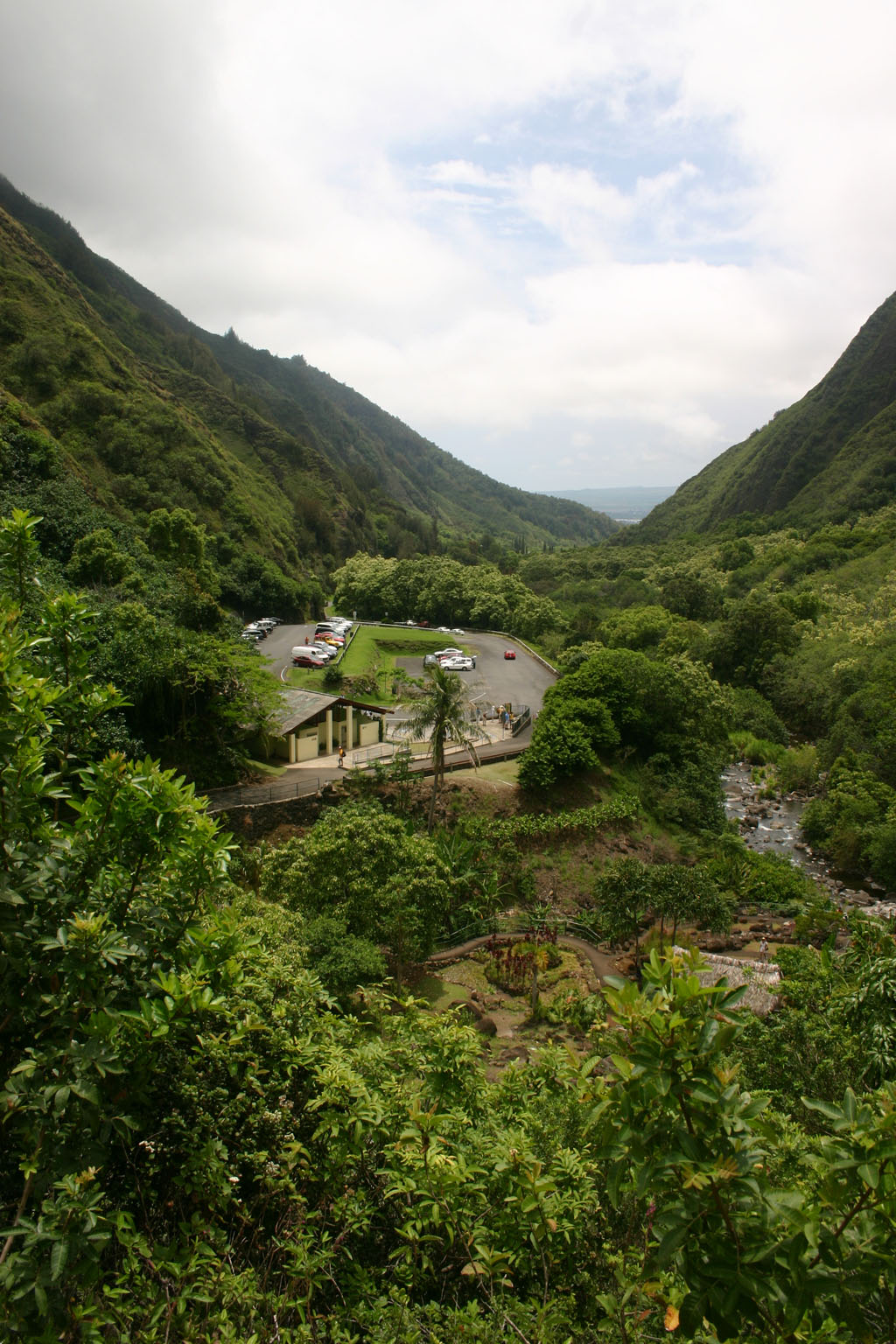
View looking out of the valley toward the parking lot, and Wailuku beyond. (Bonus Where’s Waldo point: Find the shaka.)
DETAILS:
‘Iao Valley State Park is on virtually every guidebook and tourist pamphlet’s short-list of must-see places – and for good reason. It is easily accessible by car or tour companies, has paved walkways, steps, and signage with historical information. It is also dramatically scenic and particularly well suited for older folks and kids.
The second wettest place in Hawai’i (the wettest, on Kauai, is also unofficially the wettest place on earth), the summit of the valley receives an average of over an inch of rain per day. (that isn’t an inch every day…maybe it’ll rain seven inches the day before your visit and take the rest of the week off!) Much of this water flows into the `Iao stream – and virtually every drop is drained by a massive diversion that Wailuku Water takes off just outside the park.
The main attraction here is the ‘Iao needle (Kuka’emoku) – a 1200′ (2250′ from sea level) high peak created by erosion of the softer rock around it over many millennia. In Hawai’ian culture, it is known as the phallic stone of the god of the ocean (Kanaloa.) They must not have wanted to share this view when they erected the lookout deck – because any normal person will wonder what kind of Freudian case-study thinks of a phallus when they see this scene. But if you look from a different angle (hint: parking lot) you can see a much clearer (if less impressive) view of the whole package.
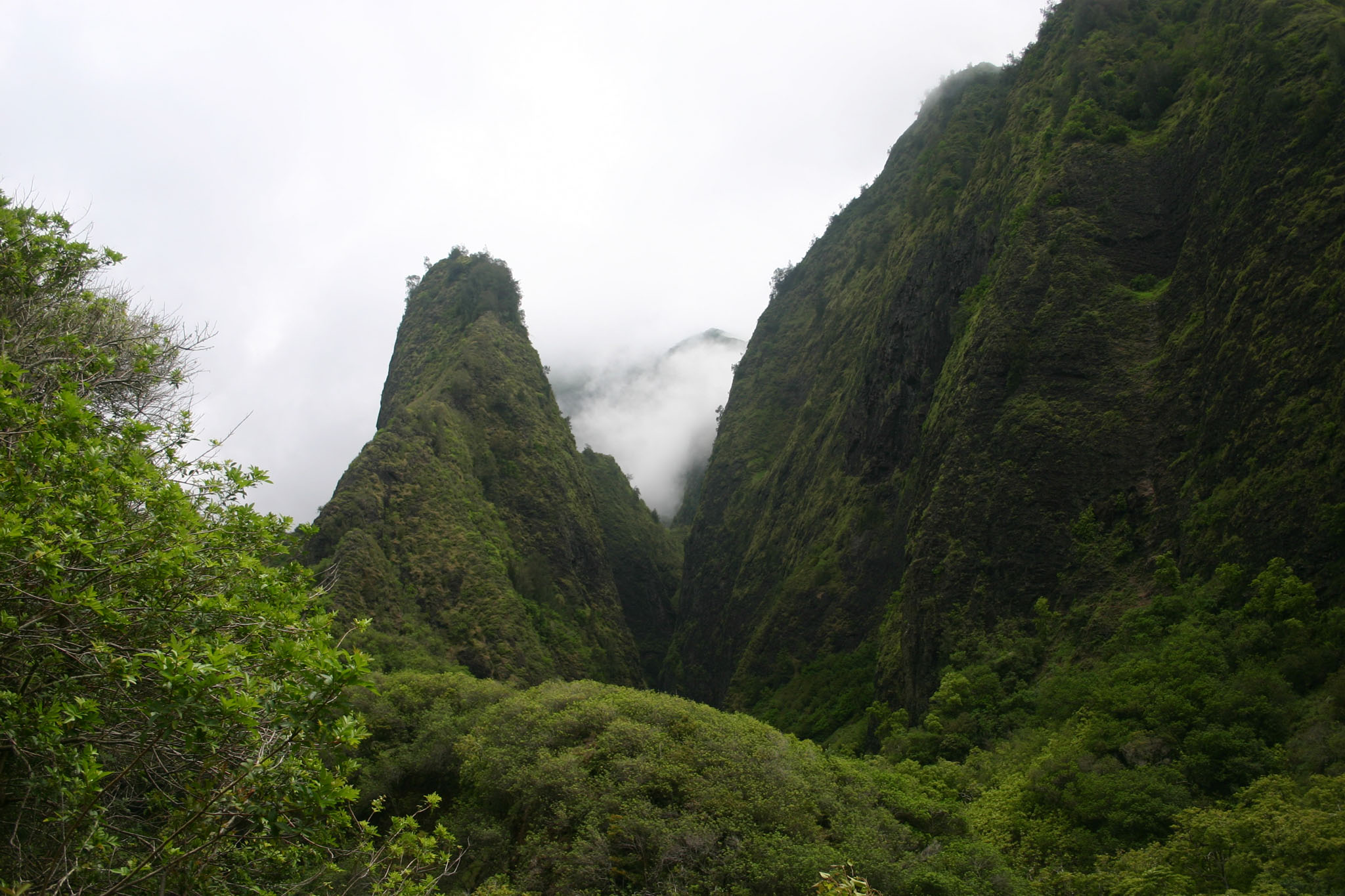
Iao Needle – View from observation deck.
This valley is sacred and was kapu to all but Hawaiian royalty. The sheer, inaccessible cliffs in `Iao Valley were used as a burial site for Hawai’i’s ali'i for centuries. Ancient Hawaiian’s believed that their bones contained their mana. Desecrating or stealing bones could give power, control, and even cause harm to living descendants.
When you first enter the park you can choose to cross a footbridge or descend to an exhibition area where the park has simplistically modeled what the greater valley (just outside of ‘Iao) once was. They have constructed a hale with thatched roof common for the time, and have many examples of plants that were cultivated in pre-contact Hawai’i. The park has struggled for years with the model lo'i in this section. You may get lucky and see taro growing – though while well intentioned, these lo’i simply do not accurately portray the vast area of Na Wai Eha that once sustained tens of thousands of Native Hawaiians. (If you’re interested in taro, you can see several producing and lovingly tended examples of lo’i along the Road to Hana.)
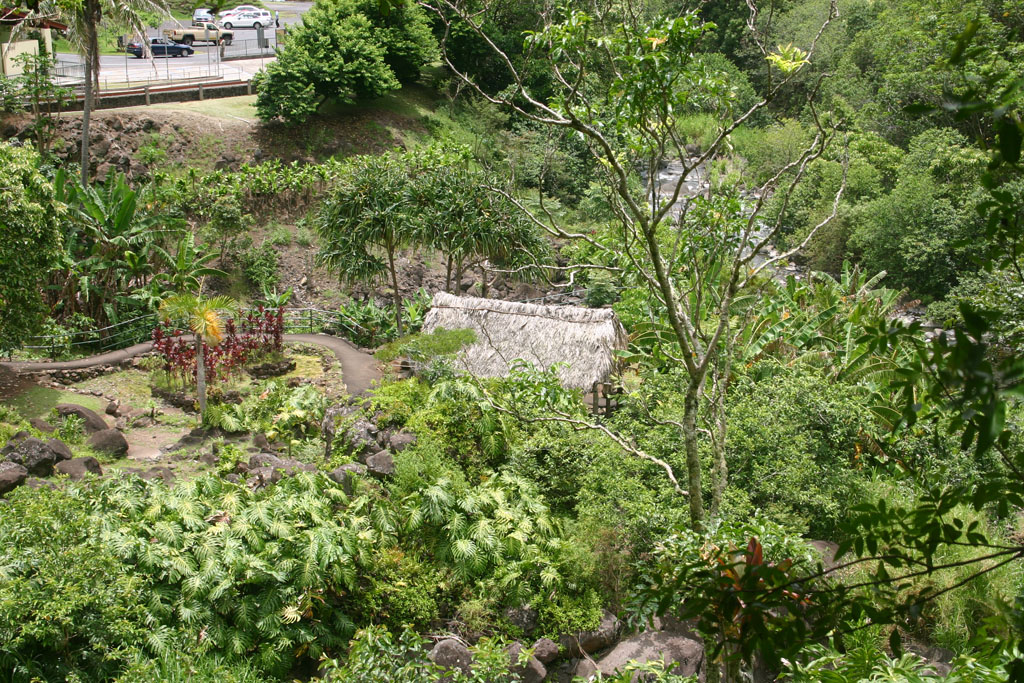
Interpretive hale with thatched roof set in garden including many examples of plants that were cultivated in pre-contact Hawaii
Heading back up to the foot-bridge, you’ll typically see local kids jumping off into a small pool below. Like most teenagers, they may come off as too cool to pay attention to you, but they’re most definitely there for your attention. (There are plenty of better jumping options close by if they didn’t want a steady stream of tourists walking by as witness to their coolness!) So feel free to observe, yell some encouragement or even throw ’em a shaka!
After the bridge you have the option to go up or down. Taking the high road brings you to the `Iao Needle observation deck. Down takes you to the stream, and a short nature loop (with access to many informal trails.)
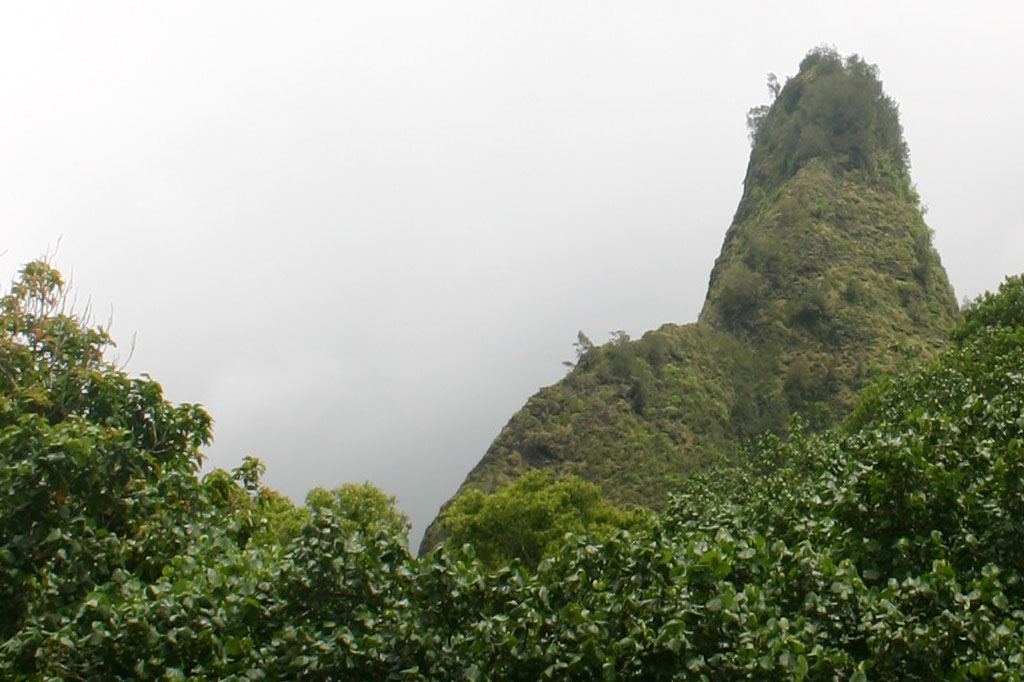
Oh, now I get it…
There are trails that follow the stream and go into the valley alongside Iao stream (some access points have signs marked not to follow.) I’m not gonna tell anyone to follow them, but I will tell you there are some nice places to enter the stream (when safe), and to my knowledge there is no kind of enforcement or land ownership in this area. Speaking of extra trails, there are also some nice places along the park access road (before the park) to jump and swim as well – from them you can follow more of the trail network. In those places, however, you may run into local folks who aren’t so happy to see you there. I’d advise being respectful (if they wanted to swim with a throng of visitors, they’d be jumping with their show-off buddies at the foot bridge.)
On the road through ‘Iao Valley, and before the State Park there is also the Kepaniwai Park Heritage Gardens. The gardens memorialize the multicultural history of Maui, with buildings and gardens representing Hawaiian, American missionary, Chinese, Japanese, Portuguese, Korean, and Filipino cultures. The gardens were restored in 1994, and are a nice place to stroll around, and have a picnic lunch.
Next door to the Kepaniwai Park Gardens is the Hawai’i Nature Center. Unfortunately the museum has been permanently closed to walk-in visitors.
Key Info:
Location: End of Iao Valley Rd (extension of Main St aka Hwy 320)
GPS Coordinates: 20.880576,-156.545166
Facilities: Bathrooms. (Kepaniwai Park just before the park has sheltered picnic tables & BBQ’s)
Get directions
View ‘Iao Valley State Park in a larger map
Rod McInnes says:
The Iao Valley was a pleasant surprise after visiting the dry, rain shadow south Maui area. The valley was so lush, succulent and green with fast flowing streams and steep sided mountains covered in mist and clouds in the West Maui mountains. The short 3 mi drive west from Kahalui is on a nicely paved roadway that winds past a farm stand, residential houses and nature centre after passing through Wailuku. The paved pathway and 135 steps to the Iao Needle viewpoint was easy going and super scenic with the greenery and fresh, mountain streams meandering down the steep slopes. A must visit if you have an hour or two to spare, its so refreshing up there.
Tammy Estrada says:
Aloha, I am a resident that just begun hiking beautiful Maui with my family. My grandson is two . Would this be safe for him or should I bring the stroller? I am a beginner hiker would this be appropriate for an older lady? Any other suggestions? We would love to find a spot to let the kiddo run and still be safe. Mahalo for your time, Tammy
Lusana says:
Mahalo for writing about the most sacred ‘Iao Needle & Valley. Please know the land itself is extremely sacred & kapu. Wandering into & exploring off the marked trails is incredibly disrespectful & trespassing. Of course local people are going to react…. especially those trained in the Hawaiian culture & practices.
If you were a staunch Catholic, you wouldn’t explore the unmarked areas of the Vatican because you didn’t see a guard. You go where you have been given permission. You go where the guide to the Vatican takes you.
Thus we ask that you respect the ‘Āina – all of the land & ocean, & all beings here… especially that which clearly is marked sacred & kapu.
Mahalo nui loa.
Mary says:
It is called respect. Maui is so very beautiful and it speaks to my soul every time I visit. To know that people would blatantly disregard signs, markers and specific walkways, well it’s just wrong on every level. That they would do anything to harm it makes my heart so very sad. I saw several rainbow eucalyptuses that people had carved their initials on. Why? Why would anyone deface something so beautiful? We not only need to leave it unmarked for the great people of Hawaii but for the future generations to enjoy. I am planning my next trip and can’t wait to be back. Mahalo for sharing your beautiful islands.
Claudia Oliveira says:
Thanks for all information
Marlo says:
I would like to learn more about this sacred site with all the greatest of respect. Can you point me to any books or resources about the sacred practices and history of the Iao Needle and the land around? Thank you so much! 🙏🙌
Virginia says:
What kind of tree is the large one down by the stream?
J Holloway says:
Pretty sure it’s an Albizzia, which is not necessarily a good thing: https://isaiahstreeservice.com/the-history-of-albizia-trees-on-kauai/
Joel says:
Will it be open during the first week of September 2018?
Julie says:
Any way to know if this Park is open now?
Mark says:
You’re in luck, it reopens tomorrow 🙂
Coconut Condos says:
Kudos to whoever writes these…pretty great paragraph about the “main attraction”.
Jordan Antonucci says:
Thumbs up for sure
Jonathan says:
Iao Valley State Park is closed until further notice. We tried to go today and there is a police officer at the road to ensure that no one goes in. Apparently there was major floodinga few weeks ago and the cop says it will not open “for a few months.” If you plan to go to the park find a way to make sure it is open before driving there. I wasn’t able to find anything on the website, and I couldn’t find a phone number.
Pat says:
We also tried to go to the park 2 days ago and it was still closed. No information about when it will be opened. Sad. We are bitterly disappointed.
Willy says:
Why didn’t ‘Iao Needle erode ?
B!rd says:
It’s made of a different kind of rock that is not as easily eroded as sandstone but it will eventually erode
Myia says:
What time does the park close?
Helen Shaw says:
Just too mention that you have to pay the $5.00 entrance fee by credit card! Bizarre!!
Alex says:
Not true as of 4/27/2018
Lusana says:
Why is it bizarre to pay an entry fee? It costs money to maintain trails, keep the restroom clean & supplied with toilet paper. Credit cards facilitate transactions.
Yohanni says:
I agree with you. $5 is nothing and can’t believe people complain for $5.
Dylan says:
OMG i am going there for Huakaʻi Aloha Aina, yayyyyyyy
Cal says:
In 1963/4 I walked up the valley to the parking lot at the Needle. I was 20 at the time so it was an easy climb.
Ron Van Pool says:
Does anyone know the history of the swimming pool in Heritage Park in the Iao Valley?
Lee says:
In 1964, just across the street from Heritage Park, was the Iao Valley Inn. It was a small hotel with a restaurant and cocktail lounge. It also had a swimming pool in the front just above the road by the park. Maybe this is the pool that you refer to. I haven’t been there in over 30 yrs. so I don’t know what it is like now.
Rick Christin says:
I believe that’s where we stayed in the mid to late 70’s I remember a perfect view of the needle. I was just watching the Disney movie “moana” and the place that each chief puts a stone on top of a hill I told them it looks exactly like a place I visited on the island Maui (ironically the name of the demigod in the movie) so I googled it to show them and it’s exactly how I remember. Stunningly beautiful